

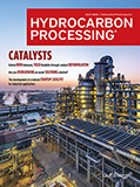
Reactors
Ethylbenzene plant debottleneck with a high-activity transalkylation catalyst
Modern commercial ethylbenzene (EB) plants use liquid-phase alkylation processes with zeolite catalysts to achieve high product yields.
Key instrumentation technologies to tackle the toughest measurement challenges
Just as some people seek out extreme sports, process manufacturing has its extreme applications, and engineers who design for these environments must find ways to safely contain and monitor all manner of dangerous reactions and products.
Separating from the competition: Recovering profits after the pandemic
As recovery from the COVID-19 pandemic begins, so will a return to normal life.
Stability evaluation of hot spots in the RDS process reactor
During the end-of-run (EOR) period of the authors’ company’s residue hydrodesulfurization (RDS) process in early February 2019, some hot spots occurred in the catalysts of the reactors.
Show Preview: IRPC Process Technology
IRPC Process Technology: The latest advancements in process technologies
Editorial Comment: Maintenance and reliability—A cornerstone of safe and efficient plant operation
Refineries and petrochemical plants are comprised of a series of crucial processes to produce transportation fuels, products and chemicals demanded by the global market. These processes consist of capital-intensive units that must be maintained to provide reliable performance. Failure to adequately maintain these assets can have a detrimental effect to not only operations and profit, but also to worker safety.
TOTAL refineries improve overhead systems corrosion and salting with amine-neutralizing technology
Weak organic amines are commonly used in crude unit overhead systems to prevent acidic corrosion from chlorides and other acidic contaminants via a neutralization reaction.
A solution to the IMO 2020 MARPOL Annex VI requirement
On January 1, 2020, a new requirement limiting the sulfur content of marine fuel to a maximum of 0.5 wt% went into effect.
Meeting the Tier 3 challenge with ultra-clean alkylate
The U.S. Environmental Protection Agency (EPA) introduced Tier 3 gasoline sulfur standards in 2017, requiring all U.S. gasoline producers to adhere to an annual 10-ppm average sulfur limit.
Leveraging digital technologies to create the smart renewable diesel facility
Many companies are modifying existing crude refineries or building grassroots renewable diesel facilities to produce drop-in, green renewable diesel from a variety of agriculturally derived triglyceride feedstocks.
- Air Canada and Airbus launch joint initiative to scale domestic Canadian SAF 8/3
- Purdue Biofuels Consortium to bring biodiesel and ethanol blends to diesel engines 8/3
- Convertus closes on $135-MM financing for flagship biofuel facility in Ontario, Canada 8/3
- New process turns mixed plastic waste into hydrogen fuel without sorting 8/3
- Amogy and 2G Energy successfully demonstrate integrated ammonia-to-power generation with natural gas multi-fuel capability 8/3
- Iraq's Baiji refinery output unaffected by fire 8/3