


Asia deepens refining cuts due to Iran war, putting diesel and jet fuel supplies at risk
- Asia's April crude imports lowest since 2016, Kpler says
- Crude slate lightening as refiners buy more from U.S., Africa
- Diesel, jet fuel output to fall 1 MMbpd or more in April, analysts say
Asian refining throughput is set to tumble in April and May as crude imports hit a 10-year low and the Iran war forces refiners to process lighter grades, curbing diesel and jet fuel output by at least 1 MMbpd, analysts and refining sources said.
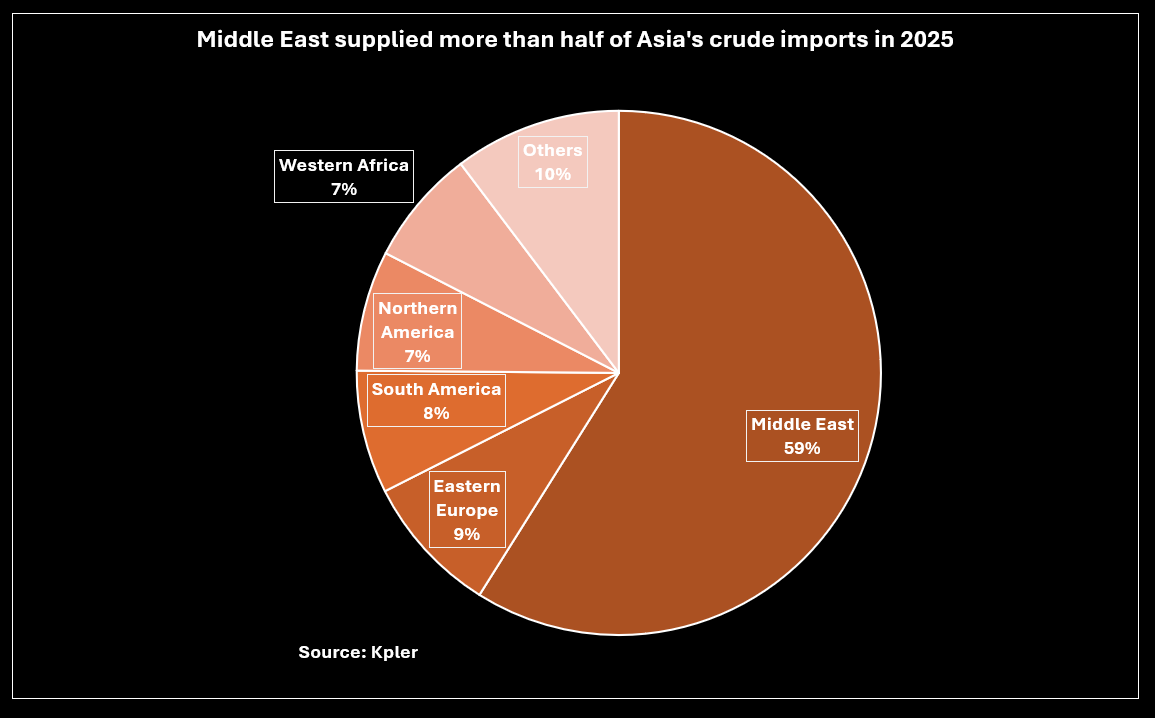
Asia, which accounts for 37% of global refining output and ordinarily sources two-thirds of its crude from the Middle East, has been hardest-hit by the closure of the Strait of Hormuz, with run cuts at refiners in the region exacerbating tight fuel supply and keeping prices elevated.
(click image to enlarge)
Crude imports to Asia are on track to fall 22% on an annual basis to 20.4 MMbpd in April, provisional data from Kpler showed, the lowest level since 2016, despite refiners snapping up sanctioned Iranian and Russian oil at sea and paying record premiums for alternatives to the Middle East.
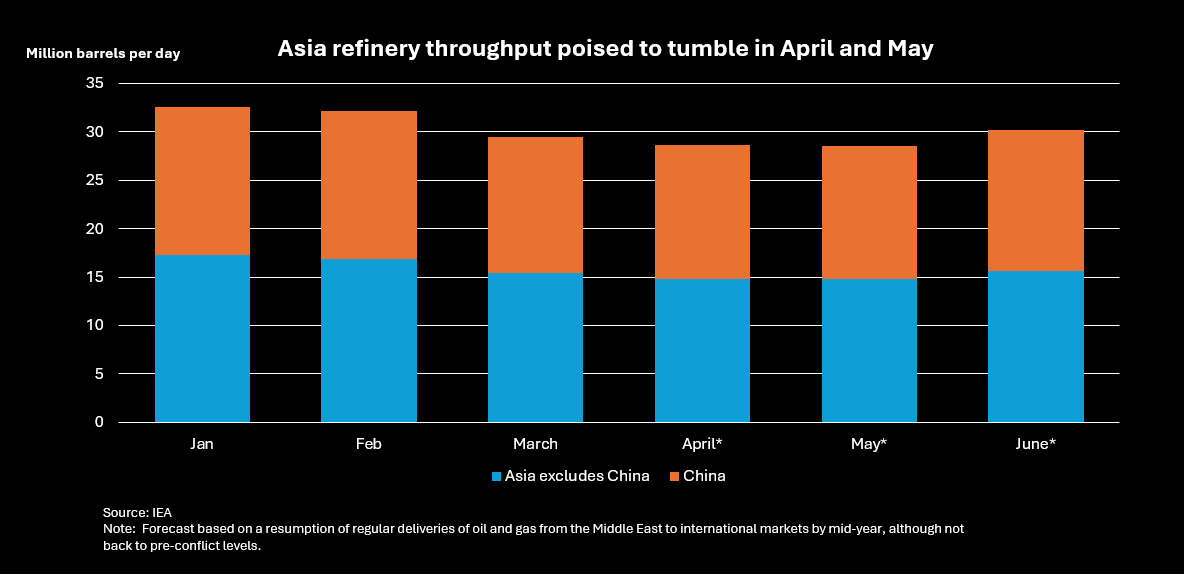
That forced Asian refineries to lower runs by 2.7 MMbpd to 29.4 MMbpd in March, with runs set to slip further to 28.6 MMbpd and 28.5 MMbpd in April and May, respectively, the International Energy Agency said.
(click image to enlarge)
Consultancy Energy Aspects forecasts crude processing will fall to 28.4 MMbpd in April and 28.7 MMbpd in May, from 30.4 MMbpd in March.
"The deepest run cuts will occur in April as Middle East crude supply shortfall persisted, while alternative barrels will only arrive from this week onwards," said Amir Abu Hassan, senior oil analyst at consultancy FGE NexantECA.
While some analysts forecast recovery starting in June, that depends on a resolution to the conflict that keeps the Strait of Hormuz open.
NORTH ASIAN REFINERIES. China, home to the world's biggest refining sector, has since last month curtailed fuel exports in order to preserve domestic supply, with the IEA pegging Chinese refinery throughput at 14 MMbpd in March, down from 15.2 MMbpd in February and 14.8 MMbpd on average for all of 2025.
Chinese research firm Horizon Insight estimates China's throughput at 13.4 MMbpd in the week to April 17, down from 15.4 MMbpd in the week before the war started on February 28.
The Chinese run cuts are mainly at state-owned refineries, which have increased yields of transportation fuels at the expense of naphtha for petrochemicals for energy security, Horizon Insight analysts said.
In South Korea and Japan, refinery utilization rates will likely drop to 65% in late April and early May, FGE's Hassan said, from normal levels around 70% to 80%. In Japan, refineries are operating at around 68% of designed capacity in April, Petroleum Association of Japan data showed.
In energy hub Singapore, refinery utilization rates have averaged below 50%, down from 70% typically, Hassan said. Indian crude runs fell nearly 13% to roughly 5.0 MMbpd in April from February, said Nithin Prakash, an analyst at consultancy Rystad Energy.
LESS MEDIUM-SOUR CRUDE, MORE LIGHT GRADES COMING. Of the nearly 12 MMbpd of crude unable to reach Asia in March due to the effective closure of the Strait of Hormuz, nearly 8 MMbpd was of medium density and high sulfur content, or medium sours, which most Asian refineries are designed to process to maximize diesel output, according to Vortexa.
To replace that, Asian refiners have bought light West Texas Intermediate and medium-sour Mars grades from the U.S., Kazakhstan's light sour CPC Blend and sweet West African oil - grades that typically produce more gasoline and naphtha.
For April-loading cargoes, the share of light-sweet crude in Asia's crude slate hit a record high of 21%, Vortexa data showed, up from 11% in February.
DIESEL, JET FUEL OUTPUT LOSS. The switch in crude grades has resulted in a loss of middle distillates - diesel and jet fuel - output at Asian refineries. Middle East crudes typically produce 60% middle distillates, compared with about 40% for WTI, said Vortexa analyst Emma Li.
A 1% to 2% drop in yields across Asia's roughly 30-MMbpd refining system could translate into a loss of around 250,000 bpd–500,000 bpd of diesel and jet supply, Rystad's Prakash said, which combined with export curbs by some governments and refinery run cuts could reduce diesel and jet fuel availability by a combined 1 MMbpd in the near term.
Sumit Ritolia, Kpler's modeling and refining manager, estimated total middle distillate supply losses in April at 1.8 MMbpd–2 MMbpd, most of that diesel.
A lighter crude slate will lead to lower utilization of secondary units such as cokers and hydrocrackers, designed to upgrade residual fuel into diesel, he added.



Comments