

Digital Exclusive: Diesel demand, FCC flexibility and the growing role of additive technologies
A. GRANADOS, Honeywell Technologies, The Randstad, Netherlands; and J. MAYOL, Honeywell Technologies, Aix-en-Provence, France
Global fuel markets are entering a period of sustained complexity. While long-term energy transition goals continue to evolve, near-term realities remain firmly grounded in liquid fuels. Diesel continues to play a central role in freight, agriculture and heavy industry, making it one of the most economically critical refined products.
At the same time, supply dynamics are becoming more volatile. Recent analysis from the International Energy Agency1 has highlighted how disruptions to key transport routes can rapidly constrain global oil and refined product flows, placing significant pressure on markets for products such as diesel. These shifts, combined with changing trade patterns and regional imbalances, are increasing the need for operational flexibility within refining systems.
For refiners, this creates a familiar but increasingly urgent challenge. How can existing assets be used more flexibly to respond to changing product demand, without incurring significant capital expenditure or long implementation timelines?
Fluid catalytic cracking units (FCCUs) sit at the center of this question. Designed primarily to maximize gasoline production, FCCUs are among the most versatile conversion assets in the refinery. However, that flexibility is not always easy to access. Adjusting product slates, particularly towards higher distillate yields, often involves tradeoffs that can affect conversion, unit severity and overall economics.
One of the key constraints lies in the formation of slurry, or bottoms. This heavy, high-boiling fraction represents a portion of the feed that has not been effectively converted into higher-value products. From a refinery perspective, it is both a lost opportunity and a limiting factor. Increasing distillate production, for example, often leads to higher slurry yields unless additional steps are taken to manage conversion pathways.
The challenge is rooted in chemistry. The largest hydrocarbon molecules present in FCC feedstocks are too large to access the active sites within the zeolite pore structure of the catalyst. As a result, they rely on cracking reactions that occur on the outer matrix of the catalyst particle or, in less favorable cases, through thermal cracking. The latter route is particularly undesirable, as it tends to produce coke and dry gas rather than useful liquid products, while also contributing to catalyst deactivation.
For many years, refiners have relied on a combination of operating adjustments and catalyst reformulation to manage this balance. Lowering reactor temperatures, adjusting cut points or modifying catalyst activity can all shift yields, but these approaches are not without limitations. Catalyst changes, in particular, can take months to implement and are not always suited to short-term market shifts.
Removing the bottleneck with additive technologies. This is where additive technologies are gaining increasing attention. Rather than replacing the base catalyst, additives offer a way to selectively enhance specific aspects of FCCU performance, enabling refiners to fine-tune conversion pathways in a more targeted and responsive way.
Bottoms cracking additives are a good example of this approach. By increasing matrix activity within the FCC system, they provide additional sites for the initial breakdown of large hydrocarbon molecules. This effectively creates an alternative route for conversion, allowing heavy components to be pre-cracked into smaller intermediates before they would otherwise be lost to thermal reactions.
The impact of this is twofold. First, it reduces the formation of slurry by converting a portion of the heaviest material into more reactive intermediates. Second, it shifts the balance away from thermal cracking, helping to limit the formation of coke and dry gas. In practical terms, this means more of the feed is made available for conversion into valuable products, without introducing significant operational penalties.
An important point is that additives do not dictate the final product slate. Once heavy molecules have been converted into intermediate material, their ultimate destination depends on the broader catalyst system and operating conditions. Factors such as zeolite activity, hydrogen transfer and the presence of ZSM-5 additive will determine whether these intermediates are converted into diesel-range material, gasoline or lighter olefins.
The authors’ company’s proprietary additivea is one example of how this concept is applied in practice. Designed as a separate catalyst particle with high matrix activity, it enhances the ability of the FCC system to process heavier fractions of the feed. By promoting catalytic cracking pathways at an earlier stage, it helps convert material that would otherwise contribute to slurry into intermediates that can be further upgraded within the unit.
Such additive approaches have demonstrated consistent performance across a range of FCCUs and feedstocks, providing a proven route to reducing bottoms yield while maintaining operational stability. As with other bottoms cracking additives, the benefits are typically seen in reduced slurry yields and increased availability of intermediate streams, particularly in the light cycle oil (LCO) range (FIGS. 1 and 2). Crucially, this is achieved without a significant increase in coke or dry gas production, even in units processing feeds with higher levels of contaminant metals. This balance is essential for maintaining unit stability while pursuing higher-value yields.
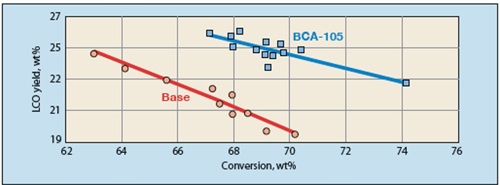
FIG. 1. The authors’ company’s proprietary additive’sa performance: slurry yield vs. conversion.
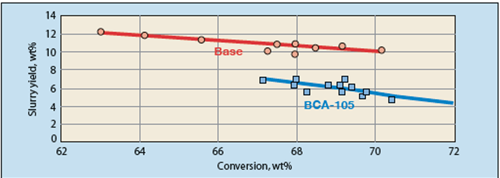
FIG. 2. The authors’ company’s proprietary additive’sa performance: LCO yield vs. conversion.
Typical yields of the authors’ company’s proprietary additivea in LCO mode is detailed in TABLE 1.
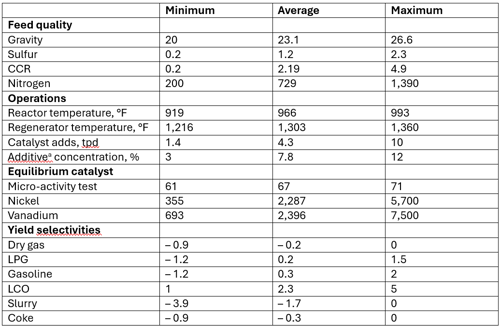
TABLE 1. Typical yields of the authors’ company’s proprietary additivea in LCO mode
Flexibility as a competitive advantage. Beyond the chemistry, the operational advantages of additives are equally significant. Because they are introduced as standalone components, they can be added, adjusted or withdrawn without the need to reformulate the base catalyst. This provides a level of agility that is difficult to achieve through catalyst changes alone.
In practical terms, refiners can respond to shifts in market demand over significantly shorter timescales than catalyst reformulation. This is increasingly important in a market where diesel fundamentals remain tight relative to other refined products, influenced by refinery capacity constraints, maintenance cycles and evolving trade flows.
It is also worth noting that additive strategies are most effective when used as part of a broader optimization framework. Operating conditions, base catalyst formulation and complementary additives such as ZSM-5 all play a role in determining overall performance and yields. Bottoms cracking additives should therefore be viewed not as a standalone solution, but as one element within a wider toolkit that enables refiners to manage complexity and maximize value.
Looking ahead, the importance of this kind of flexibility is only likely to increase. Feedstocks are becoming more variable, with greater use of opportunity crudes and more challenging residues, while demand patterns continue to evolve alongside regulatory and regional pressures. In this context, the ability to adapt quickly, using existing infrastructure, will be a defining factor for refinery performance.
Additive technologies offer a practical way to achieve this. By targeting specific constraints within the FCC process, they allow refiners to unlock additional value from their assets while maintaining control over operational risks. As the industry continues to navigate uncertainty, these kinds of incremental, flexible solutions are likely to play an increasingly important role.
For refiners, the question is no longer whether flexibility is required, but how quickly it can be achieved. In many cases, the answer may lie not in large-scale changes, but in smarter use of the tools already available within the FCC system.
NOTE
a Honeywell Technologies’ BCA-105TM additive
LITERATURE CITED
1 IEA, “Sheltering from oil shocks,” March 20, 2026, online: Sheltering From Oil Shocks – Analysis - IEA


Comments