


China's crude oil imports slump, but it's economics not altruism
China's seaborne imports of crude oil slumped to the lowest in almost 10 years in May as the impact of the Iran war led to a dramatic reshuffling of operations in the world's biggest oil importer.
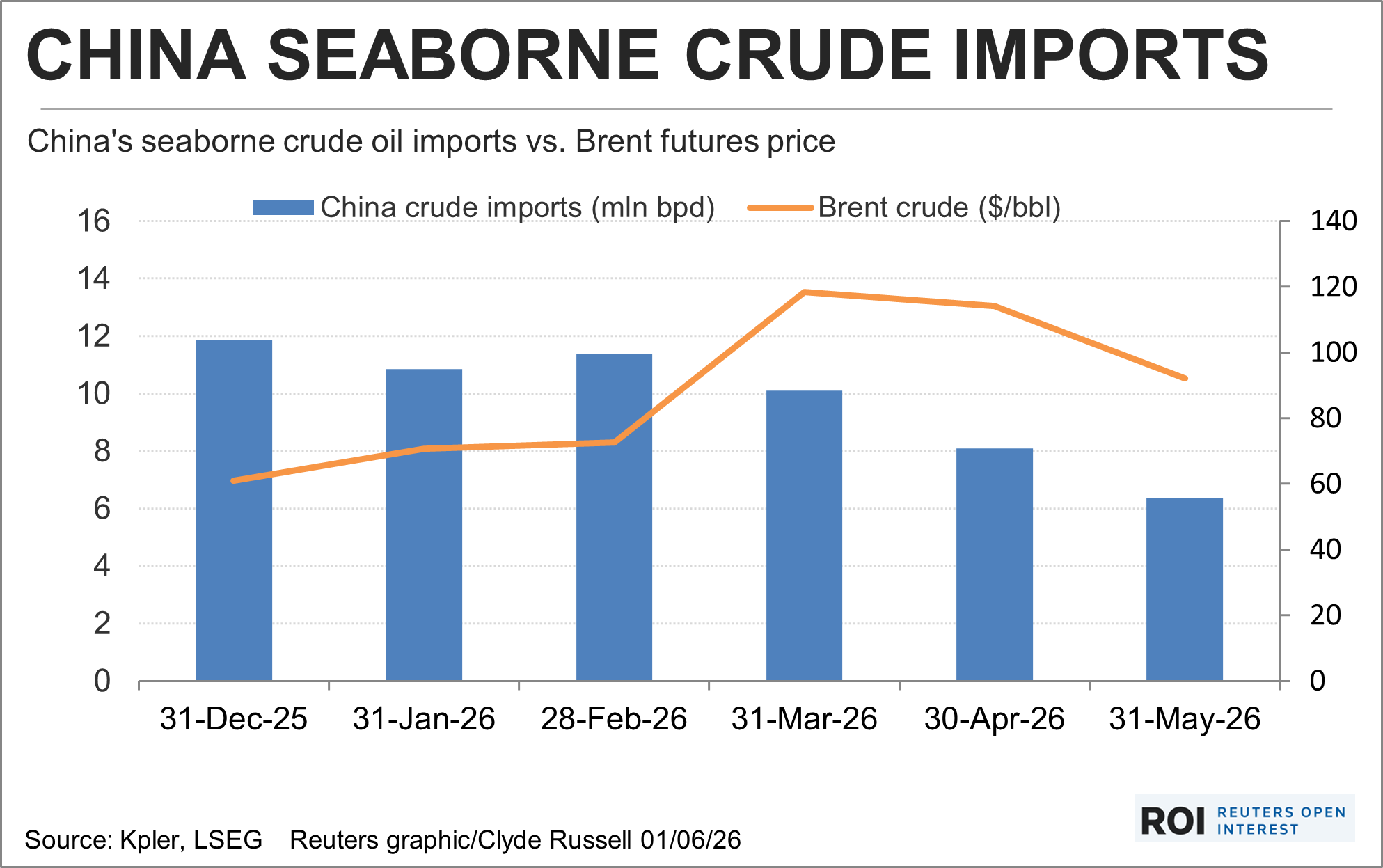
Seaborne arrivals of crude were 6.36 MMbpd in May, down from 8.10 MMbpd in April and the weakest since October 2016, according to data compiled by commodity analysts Kpler.
(click image to enlarge)
Imports were also nearly half the 11.39 MMbpd recorded by Kpler for February, the last full month of arrivals prior to the U.S. and Israeli attack on Iran on February 28.
The collapse in China's imports is being framed in media and market commentary as helping Asia adjust to the loss of at least 10 MMbpd of crude from the effective closure of the Strait of Hormuz.
While this is true, it is a serendipitous side effect rather than any altruism on Beijing's part, which is responding to changing price and supply dynamics.
It's clear that the conflict in the Middle East is the primary driver behind the collapse in China's oil imports, but the real challenge is in working out the why and the how of what China is doing to adapt to the loss of as much as 10% of global crude supplies from the Iran conflict.
The first factor is that China is following the usual pattern of cutting back on imports when prices rise sharply.
When global benchmark Brent crude futures LCOc1 soared in the wake of Russia's invasion of Ukraine in February 2022, reaching a peak of $139.13 a barrel in March 2022, China's seaborne imports dropped from 10.84 MMbpd in January 2022 to 8.07 MMbpd by June of that year.
A swing of up to 2 MMbpd in monthly imports in response to sharp price moves isn't unusual for China, but the collapse in arrivals from February to May this year is a far larger 5.5 MMbpd.
This suggests that higher prices weren't the only factor behind the drop.
It's also likely the case that Chinese refiners were struggling to source crude from their usual suppliers, especially those cut off by the closure of the Strait of Hormuz.
Imports from Iraq went from 790,000 bpd in February to just 60,000 bpd in May, according to Kpler, while those from Kuwait dropped from a recent high of 522,000 bpd in October to zero in May.
RUSSIAN CRUDE. It wasn't just imports from Middle East producers that were affected, with seaborne arrivals from Russia dropping to 1.07 MMbpd in May, the lowest since August and down from 1.96 MMbpd in February.
Up until the Iran war China was the only major buyer for Russian crude, which was under Western sanctions since the invasion of Ukraine.
However, the administration of U.S. President Donald Trump eased sanctions on Russian oil in order to help address the shortfall of crude supplies created by its war against Iran.
This meant that India, Asia's second-biggest buyer, returned to buying Russian crude, with arrivals of 2.17 MMbpd in May, a record high and double the 1.07 MMbpd in February.
The combination of higher prices and supply issues help explain the decline in China's May crude imports, but not how the country is adjusting to such a massive drop.
It's likely that refiners have shifted their product mix as far as they are able to maximize output of middle distillates such as diesel and jet fuel, as well as gasoline.
The sector being crunched is light distillates for petrochemicals, and producers of plastics are likely being forced to use up inventories to keep running.
It's also unlikely that China is as yet tapping its Strategic Petroleum Reserve (SPR), rather refineries are using up commercial inventories of both crude and refined products.
The sharp drop in refined product exports to just 463,000 bpd in May from 777,000 bpd in February is also keeping more fuels available for the domestic market.
However, the problem is that commercial inventories will unlikely last for an extended period, meaning China will eventually have to do one of three things, or some combination of them.
It will have to either increase crude oil imports, cut refinery processing rates sharply or tap into the SPR.
The views expressed here are those of Clyde Russell, a columnist for Reuters.



Comments