


July 2026
Special Focus—Catalysts
How pilot testing improves confidence in hydroprocessing catalyst selection
Hydroprocessing is a hydrogen (H2)-assisted upgrading process used in refineries to convert lower-value hydrocarbon streams into higher-value transportation fuels and intermediates. These reactions are typically carried out in industrial trickle-bed reactors, a fixed-bed configuration widely applied in hydrotreating and hydrocracking service. In this reactor type, liquid hydrocarbons and H2-rich gas flow concurrently downward through a packed catalyst bed, establishing the gas-liquid-solid contact required for hydroprocessing reactions. Commercial operation is defined by controlled ranges of superficial velocity, liquid space velocity and H2-to-oil ratio to maintain the desired mass transfer and reaction environment.
Under trickle-bed flow conditions, which typically occur at low to moderate gas and liquid rates, the liquid phase moves through the catalyst bed as a thin, discontinuous film over the catalyst surface, while the H2-rich gas remains in the continuous phase in the void space between particles. Both phases contact the heterogeneous catalyst simultaneously; therefore, reactor performance depends strongly on catalyst wetting, H2 availability and access of reactants to active sites.
These considerations become especially important when interpreting pilot plant data. While commercial units generally operate under stable and optimized conditions, pilot plants often require modified flow regimes, elevated H2-to-oil ratios, higher superficial velocities or the addition of diluents to reproduce the wetting, heat transfer and mass transfer behavior of larger industrial units.
Pilot data should, therefore, be extrapolated to full-scale operation with caution, considering scale-dependent hydrodynamic limitations, catalyst activation methodology and the industrial relevance of the selected performance indicators.
Hydroprocessing unit at different scales. TABLE 1 illustrates the dimensional and hydrodynamic differences among hydroprocessing reactors operated at a constant liquid hourly space velocity (LHSV) of 1 h⁻¹. As reactor size decreases from commercial scale to pilot and microreactor scale, the corresponding linear liquid velocity declines significantly and may be on the order of 100–200 times lower than in industrial units, particularly in high-throughput systems.
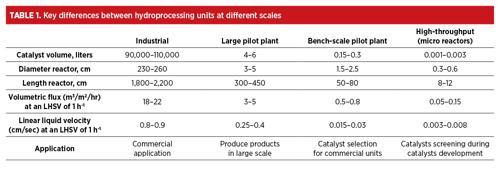
These geometric differences impose fundamental scaling constraints in trickle-bed reactor operation. As a result, it is not possible to simultaneously match both LHSV and superficial velocity between pilot-scale and commercial reactors. Even at identical LHSVs, pilot units operate at substantially lower mass flux, typically around 20–40 times lower than industrial units and potentially even lower in microreactor systems. This can introduce mass-transfer limitations and lead to deviations in the apparent catalyst performance.
Pilot reactors inherently operate at lower superficial mass flux than commercial hydroprocessing units; consequently, pilot plant configuration, reactor selection and operating strategy must be—as much as practicable—designed to suppress external heat- and mass-transfer artifacts. If these non-kinetic effects are not adequately mitigated, the test system may exhibit incomplete catalyst wetting, elevated axial dispersion and significant interphase, as well as intra-particle transport gradients, causing the measured reactor response to diverge from the intrinsic kinetics of the catalytic system. The result is an apparent loss in activity or conversion that reflects transport constraints rather than true catalyst performance. These distortions become increasingly severe as reactor scale decreases, particularly in high-throughput microreactor platforms, where the risk of non-representative catalyst ranking is especially high.
At reduced scale, reactor geometry directly alters gas-liquid-solid contacting and, therefore, the apparent catalyst response. Lower linear velocity, shorter bed length and smaller reactor diameter increase the likelihood of axial dispersion, wall flow, incomplete wetting and H2 starvation. Unless these effects are mitigated, the measured activity may reflect hydrodynamic limitations rather than intrinsic catalyst kinetics, leading to non-representative catalyst ranking, particularly in high-throughput microreactor systems.
There are fundamental operational differences between commercial hydroprocessing units and pilot plants that must be understood when interpreting catalyst performance. TABLE 2 summarizes the key parameters and contrasts how they are handled in both environments. The pilot plant operates under isothermal conditions, allowing for better control over catalyst evaluation, whereas commercial units are adiabatic, using heat management and quench injections to control temperature.
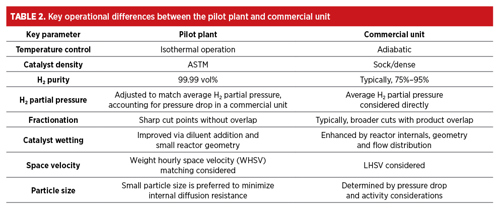
To compare the two systems meaningfully, the weighted average bed temperature (WABT) in the commercial unit is matched to the pilot operating temperature. The pilot plant uses highly pure H2 (99.99 vol%) and adjusts the H2 partial pressure to match the average seen in the commercial unit, ensuring comparability.
In terms of product recovery, the pilot plant applies sharp fractionation cut points, which ensures precise product yield assessment. In contrast, commercial units may experience product overlap due to broader cut ranges and tray efficiencies in distillation columns.
However, pilot units that are not equipped with online stripping or continuous vapor–liquid separation can experience inconsistencies in the reported product sulfur. Over-stripping during offline sample preparation can artificially increase measured product density and underestimate sulfur content, whereas insufficient stripping or cooling may lead to elemental sulfur (S₈) re-precipitation, causing erratic analytical results. Ensuring consistent sample handling and implementing controlled online stripping are essential to avoid false interpretation of catalyst activity and selectivity. A similar phenomenon is observed for the organic nitrogen measurement during hydrocracking pretreat evaluation.
Regarding catalyst particle size, the pilot plant uses smaller particles to reduce internal diffusion resistance and increase the length-to-particle diameter (L/dₚ) ratio. While commercial units can use larger or mixed particle sizes to manage pressure drop, it remains important to match WHSV in the pilot plant with commercial conditions to compare intrinsic catalyst activity on a per-mass basis. To ensure plug flow in the pilot plant reactor, diluent is added to improve catalyst wetting, thereby maximizing catalyst utilization.
Best practices for eliminating constraints. Pilot-plant testing is central to catalyst qualification, yet the reliability of the resulting data depends critically on both test design and pilot-unit configuration. Differences in activation conditions, catalyst size, temperature profiles and H2 distribution can lead to substantial discrepancies between pilot-scale results and commercial performance.
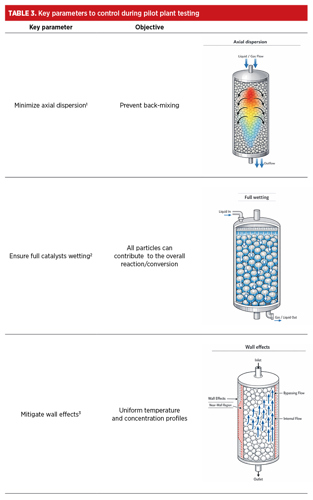
In pilot-scale trickle-bed reactors, minimizing scale-dependent deviations further requires suppression of axial dispersion, uniform catalyst wetting and mitigation of wall flow effects. TABLE 3 summarizes the key parameters that must be controlled to ensure reliable catalyst evaluation and robust scale-up to commercial operation. Both empirical and theoretical studies underscore the importance of reactor geometry, particularly a high reactor L/dₚ ratio to limit axial dispersion, and a sufficiently large reactor-to-particle diameter (Dᵣ/dₚ) ratio to promote uniform radial liquid distribution.
Well-designed pilot plants can largely control key hydrodynamic and operating artifacts; high-throughput microreactors cannot, because their extremely small catalyst inventories inherently amplify scale effects. Therefore, microreactors are suitable for rapid catalyst screening, but not for rigorous quantitative ranking. In particular, severe H2 limitation and transport distortions can invert the apparent activity sequence, such that a catalyst performing best in a microreactor could perform the worst in the actual hydroprocessing unit, and vice versa. Furthermore, alteration of the catalysts’ particles length before loading in microreactors can compromise the activity, primarily due to the fact that commercial-grade catalysts are impregnated for an optimized size and shape.
The reliability of pilot plant data is also highly dependent on the temperature program. If testing is initiated at an excessive inlet temperature, product sulfur may fall below the analytical detection limit, eliminating meaningful activity discrimination. Tests should, therefore, begin at moderate severity and proceed through controlled temperature increments to preserve catalyst separation, avoid premature deactivation and maintain ranking under kinetically relevant conditions.
Hydrodynamic similarity is equally critical. Axial dispersion is characterized by the Peclet number (Pe), which expresses the ratio of convective to dispersive transport. For hydroprocessing, a Pe > 100 is generally required to approach plug-flow behavior and obtain kinetically interpretable data; a Pe = 40–100 may be acceptable for semi-quantitative comparison, whereas a Pe < 40 (L/dₚ > 350) indicates strong back-mixing and poor suitability for kinetic evaluation. Achieving such values typically requires an L/dₚ > 350, a criterion that can be met in well-designed pilot units but is rarely attainable in microreactors due to limited bed length and low linear velocity. As a result, microreactors often operate in a strongly dispersive regime where transport effects dominate observed performance.
Radial hydrodynamics can drive an additional constraint. To limit wall channeling and radial maldistribution, the reactor-to-particle diameter ratio should generally exceed Dᵣ/dₚ > 10, and preferably > 25 for heavy feeds or low liquid velocities. Although catalyst dilution, particle size adjustment and optimized loading procedures can improve flow distribution, these measures cannot fully overcome the geometric limitations of very small reactors. Likewise, complete catalyst wetting alone is insufficient if liquid distribution is poor; effective performance requires dynamic irrigation and continuous film renewal to avoid stagnant regions, mass-transfer limitation and underutilization of active sites.
Industrial reactors inherently operate at higher superficial velocities, which promote more uniform flow and suppress dispersion. By contrast, pilot and especially micro-scale reactors are far more susceptible to axial and radial maldistribution. Consequently, meaningful catalyst evaluation and scale-up require strict control of H2 availability, temperature progression, axial dispersion, wetting quality and reactor geometry, particularly Pe, L/dₚ and Dᵣ/dₚ.
High-throughput reactors: Fit-for-purpose for focused screening, not catalyst selection. Modern third-party pilot facilities may provide excellent analytical precision, continuous data acquisition and strong mass-balance closure, but analytical quality alone does not guarantee hydrodynamic representativeness. However, the intrinsic geometry of high-throughput microreactors imposes significant hydrodynamic constraints. Reactors operated with catalyst loading below approximately 10 ml, often combined with small reactor diameters and fine extrudates, are inherently more susceptible to wall effects, axial dispersion and non-uniform wetting. Consequently, gas-liquid-solid contacting, H2 availability and overall mass-transfer behavior can differ substantially from those in industrial trickle-bed reactors.
Microreactors are useful for focused screening and trend identification, but their small dimensions make them inherently more susceptible to axial dispersion, wall effects, H2 starvation and fouling. They should, therefore, not be used for final catalyst selection nor quantitative benchmarking. Such decisions should be based on data from a properly designed larger pilot unit with representative hydrodynamics and catalyst-specific activation procedures.
In-situ activation as a key for pilot plant testing success. The development of hydroprocessing and hydrocracking catalysts with high activity for sulfur and nitrogen removal and aromatic saturation is critical for upgrading increasingly refractory refinery feedstocks into higher-value products. Industry demand continues to shift toward more active catalyst systems capable of processing heavier and more difficult feeds, increasing volume swell and extending cycle length.
However, the evaluation and activation of these next-generation catalysts at pilot scale require tighter control of sulfiding and operating conditions. This is primarily a consequence of hydrodynamic limitations inherent to small-scale reactors, including lower linear velocities, non-ideal flow patterns and less representative gas-liquid-solid contacting. These constraints can reduce H2 availability at the catalyst surface and distort the apparent catalyst response during activation and testing. Such precautions are generally not required at commercial scale, where higher superficial velocities, improved H2 distribution and more favorable flow regimes provide more representative contacting conditions.
A common client question: Is the elevated H2-to-oil ratio used during pilot testing also required in a commercial unit? The answer is no. The elevated H2-to-oil ratio is a pilot-scale compensation measure used to offset hydrodynamic and mass-transfer limitations that are intrinsic to small reactors. It is not directly transferable to commercial operation. In industrial units, superior H2 distribution and more representative flow behavior enable effective catalyst activation and performance without requiring the same adjustment. In commercial units, a refinery can utilize the existing catalysts activation procedure without jeopardizing the maximum activity that can be achieved.
As shown in TABLE 4, several operating adjustments applied in pilot units, such as high sulfur content at high LHSV and an elevated H2-to-oil ratio, are primarily intended to compensate for the hydrodynamic and mass-transfer limitations associated with small-scale reactors.
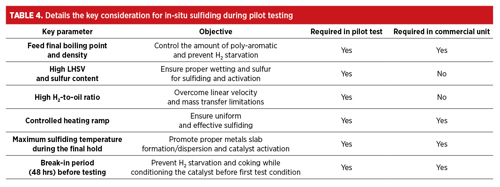
These measures help maintain catalyst wetting, sulfiding efficiency and H2 availability under conditions where low linear velocity and non-ideal flow can otherwise distort catalyst activation. In contrast, parameters such as maximum sulfiding temperature and adequate break-in period remain fundamentally important at both pilot and commercial scale, as they govern the formation and dispersion of the active sulfide phase and help prevent H2 starvation and coke formation during initial catalyst conditioning.
Heating ramps are more critical in commercial units than in pilot plants because pilot units are typically operated under isothermal conditions, whereas commercial-scale units are often closer to adiabatic operation and can, therefore, be more prone to uncontrolled exotherm development. Feed properties, particularly final boiling point and density, also play a critical role by influencing polyaromatic content and the associated risk of H2 depletion during activation.
Takeaways. Third-party pilot testing can generate reliable catalyst performance data only when the test protocol, reactor configuration, operating conditions, high-quality mass balance and analytical basis are tightly controlled. A well-characterized incumbent catalyst should always be included as an internal reference to normalize unit bias and quantify true performance differences relative to in-house data.
Reactor performance should be monitored continuously through time-on-stream trends of conversion, selectivity, sulfur and nitrogen slip, H2 consumption and pressure drop. This is essential to verify steady-state operation and to identify disturbances before they compromise data quality. Any upset should be assessed immediately for its impact on catalyst condition, including incomplete sulfiding, coking, thermal excursions or irreversible deactivation.
The analytical framework should be defined before testing begins, particularly the basis for mass-balance closure and the criteria used to compare performance across units. Feedstock quality must also be verified against the agreed specification, including boiling range, heteroatom content, metals and aromaticity.
Microreactors are valuable tools for focused screening during catalyst development, but their small dimensions make them highly susceptible to axial dispersion, bypass, wall effects, H2 limitation and fouling. As a result, data generated in microreactor systems should be interpreted with caution when used for quantitative catalyst development. Where selection decisions depend on small performance differences, confirmation in bench-scale pilot units operated under more representative hydrodynamic conditions and catalyst-specific activation procedures is recommended.
LITERATURE CITED
1 Mears, D. E., “The role of axial dispersion in trickle-flow laboratory reactors,” Chemical Engineering Science, September 1971.
2 Levenspiel, O. and K. B. Bischoff, “Patterns of flow in chemical process vessels,” Advances in Chemical Engineering, 1964.
3 Sie, S. T., “Scale effects in laboratory and pilot plant reactors for trickle-flow processes,” Revue de I’Institut Francais du Petrole, July–August 1991.



Comments