

July 2026
Special Focus—Catalysts
Extending iron tolerance and yield flexibility at ExxonMobil’s FCCU through catalyst reformulation
The processing of heavier feedstocks in fluid catalytic cracking units (FCCUs) has increased the prevalence of iron (Fe) poisoning, which can limit catalyst diffusivity, activity and operational flexibility. At one of ExxonMobil’s FCCUs, increasing atmospheric tower bottoms (ATB) processing resulted in challenging feed qualities, particularly metals like Fe and calcium (Ca). To address these challenges, a catalyst reformulation incorporating W. R. Grace & Co.’s MIDAS® MILLE™ Pro macroporosity technology was implemented.
This article presents a detailed case study of the reformulation, combining unit operating data, equilibrium catalyst (Ecat) characterization, kinetic modeling and advanced diagnostic techniques. The reformulated catalyst extended Fe tolerance at elevated added Fe levels while maintaining catalyst activity, improving yield flexibility and enabling a reduction in fresh catalyst addition rate. The reformulation delivered a reduction in catalyst additions of up to 3 tpd at constant conditions and enabled the unit to process even more ATB material.
The FCCU. FCCUs remain central to refinery value generation, as feedstock quality continues to trend heavier and more contaminated. Increased processing of opportunity crudes, resid-derived streams and ATBs has elevated contaminant metals loading in FCCUs, particularly Fe, Ca, nickel (Ni) and vanadium (V). Among these, Fe presents a distinct challenge due to its tendency to deposit on catalyst particle surfaces, form nodules and block pore mouths. This mechanism can sharply reduce effective diffusivity, restrict access to active sites and ultimately impair conversion, fluidization and selectivity.
Traditional mitigation strategies for Fe poisoning have relied on higher fresh or purchased catalyst addition rates or reduced feed rates, both of which carry economic penalties. Advances in catalyst design that directly address diffusion limitations offer an alternative approach, allowing FCCUs to tolerate higher Fe exposure while maintaining performance. This article documents a catalyst reformulation implemented in an ExxonMobil FCCU, with primary emphasis on extending Fe tolerance and secondary emphasis on preserving yield flexibility under increasingly severe operating conditions.
Unit background and operating challenges. This FCCU at an ExxonMobil facility is operated with objectives that include maximizing liquefied petroleum gas (LPG) and distillate production, maintaining strong bottoms upgrading and operating within wet gas compressor constraints. To increase refinery flexibility, the site expanded processing of ATB-derived material.
During late 2024, Ecat analyses showed significant increases in Ni and V, accompanied by rising total Fe, added Fe and calcium oxide (CaO). Added Fe plus CaO increased from approximately 0.56 wt% to as high as 0.67 wt% during the evaluation period (FIG. 1). These trends raised concerns regarding Fe nodulation, pore blockage and loss of effective diffusivity. In parallel, maintaining activity under higher metals requires elevated fresh catalyst addition rates, which increased operating expenses and led to an evaluation of a reformulated catalyst solution.
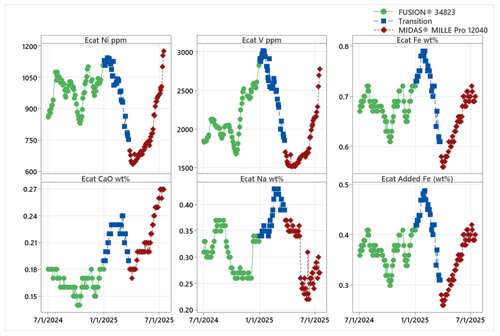
FIG. 1. Increased metals loading at ExxonMobil’s FCCU as ATB processing severity increased.
Catalyst reformulation strategy. The reformulation strategy focused on incorporating the co-authors’ company’s proprietary macroporosity technology into the catalyst blend. The technology employs a novel manufacturing step designed to increase macropore volume and optimize pore size distribution, improving internal diffusion and feed vaporization within the catalyst particle. Enhanced macroporosity mitigates the impact of surface Fe deposition by preserving internal accessibility even as Fe accumulates near pore mouths. The reformulation was validated using Grace’s iron deactivation protocol (IDP) method, which is a new Fe‑deactivation method that successfully mimics commercially Fe‑poisoned Ecat, reproducing the expected reduction in diffusivity index across different FCC catalyst systems. The Fe‑deactivated lab catalysts showed the same Fe‑tolerance trends observed in the operating unit, demonstrating that the protocol accurately reflected real‑unit metals behavior.
Rather than fully replacing the incumbent catalyst, the reformulated system balanced the new components with existing catalysts to meet the objectives of maintaining activity levels, metals trapping and coke selectivity. Reformulation objectives were explicitly defined as extending tolerance to Fe and Ca contamination, maintaining activity and diffusivity at elevated metals, preserving yield flexibility and enabling reduced fresh catalyst addition rates without sacrificing unit performance.
EVALUATION METHODOLOGY
Reformulation implementation. The reformulated catalyst was introduced into the FCCU in early January 2025 and was fully turned over by June 2025. Performance evaluation focused on stabilized operation following this turnover threshold to minimize the influence of legacy catalyst inventory.
Kinetic modeling. FCC-SIMa kinetic modeling was used to evaluate catalyst performance independent of short-term operational variability. Multiple steady-state operating periods were selected for both the incumbent and reformulated catalysts, ensuring comparable feed rates, riser outlet temperatures and catalyst circulation. The incumbent catalyst was calibrated using representative 2024 operating conditions, while the reformulated catalyst was calibrated using 2025 data and back-predicted under 2024 conditions to enable consistent comparison.
Analytical diagnostics. In addition to routine Ecat measurements, advanced diagnostics were used to assess Fe poisoning risk and catalyst health. These included inverse gas chromatography for effective diffusivity, magnetic susceptibility for Fe phase characterization and scanning electron microscopy for surface morphology assessment.
RESULTS AND DISCUSSION
Fe tolerance and diffusivity retention. A primary outcome of the reformulation was improved diffusivity retention at elevated added Fe levels (FIG. 2).
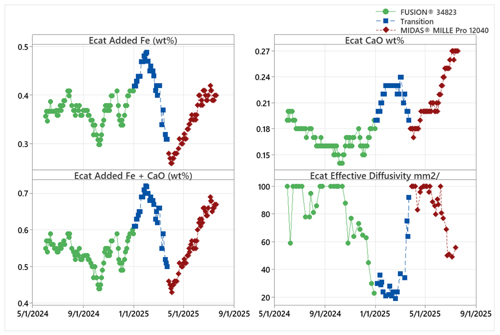
FIG. 2. A primary outcome of the reformulation was improved diffusivity retention at elevated added Fe levels.
Following reformulation, effective diffusivity stabilized at high values and declined gradually as ATB processing increased. Even at added Fe plus CaO levels approaching 0.67 wt%, diffusivity remained well above minimum recommended thresholds associated with Fe poisoning (FIG. 3).
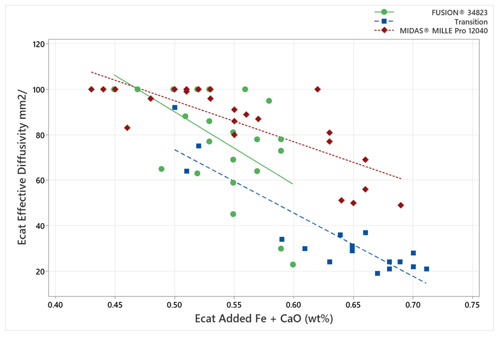
FIG. 3. Effective diffusivity as a function of added Fe and CaO on Ecat.
Magnetic susceptibility measurements returned to baseline values following reformulation, indicating reduced formation of magnetically active Fe phases associated with nodulation (FIG. 4).
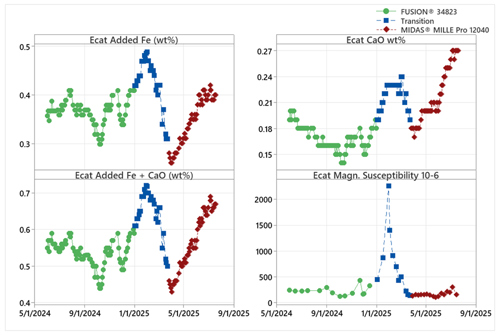
FIG. 4. Magnetic susceptibility response with increasing added Fe.
Activity maintenance. Despite rising contaminant metals, Ecat micro-activity test (MAT) values remained stable throughout the evaluation period. Activity retention was notably improved at higher metals loading, consistent with reduced diffusional limitation and preserved access to active sites (FIG. 5).
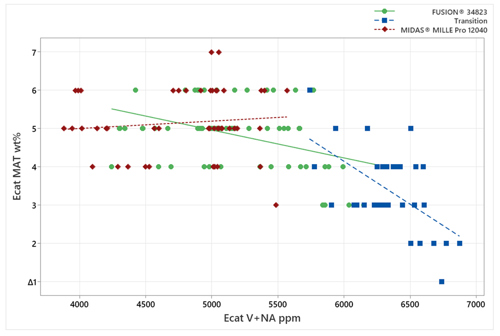
FIG. 5. MAT retention as a function of contaminant metals.
Yield flexibility. The reformulated catalyst delivered favorable yield shifts aligned with unit objectives. Dry gas yield decreased modestly, providing incremental wet gas compressor relief. LPG yield and LPG olefinicity increased, gasoline yield declined slightly, distillate yield increased and slurry yield decreased, consistent with improved bottoms upgrading (FIGS. 6 and 7).
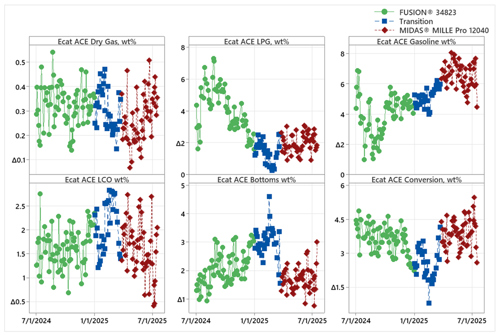
FIG. 6. Advanced cracking evaluation (ACE) yield selectivity shifts observed with the reformulated catalyst.
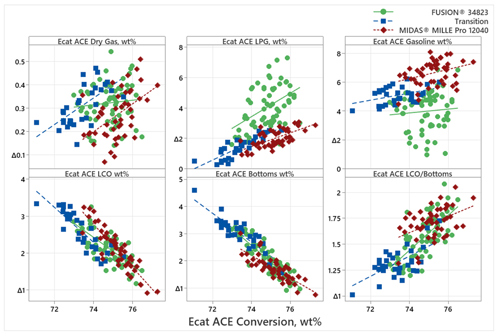
FIG. 7. ACE yields as a function of ACE conversion.
Economic impact. Improved metals tolerance and activity maintenance enabled a sustained reduction in fresh catalyst addition rate up to 3 tpd at constant conditions. The kinetic modeling indicated uplift under baseline operating conditions, reflecting a combination of improved product slate and reduced catalyst consumption. The economic modeling comparison between the incumbent and reformulated catalysts is detailed in FIG. 8.
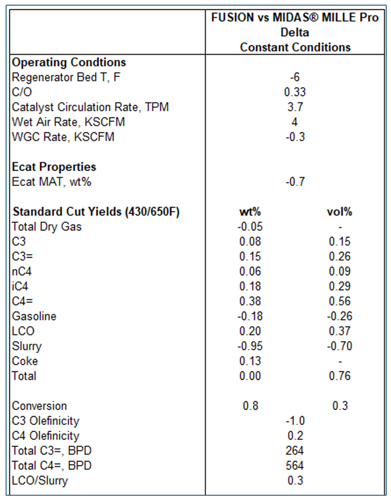
FIG. 8. Economic modeling comparison between the incumbent and reformulated catalysts.
Advanced diagnostics and Fe monitoring. Advanced analytical tools played a critical role in managing Fe poisoning risk. Effective diffusivity provided a sensitive indicator of pore blockage, while magnetic susceptibility offered insight into Fe oxide phase behavior. The scanning electron microscope (SEM) was a powerful diagnostic tool that the co-authors’ company used during the trial to visually track how Fe accumulates on the catalyst particles during a high‑Fe feed trial. As Fe loading increased, the SEM showed a transition from small, scattered nodules to larger, coalesced surface patches that were controlled by the catalyst reformulation. Comparing the SEM images across time points and catalyst grades verified that the trial stayed within the expected Fe‑growth profiles and assessed how well the catalyst design tolerated Fe under the elevated‑Fe conditions (FIG. 9).
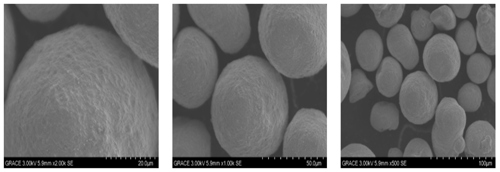
FIG. 9. SEM images illustrating catalyst surface morphology under increasing Fe exposure.
Takeaways. The catalyst reformulation implemented at ExxonMobil’s facility demonstrates that advanced macroporosity design can effectively extend Fe tolerance while preserving yield flexibility and economic performance. Under increasing ATB processing severity, the reformulated catalyst maintained activity, diffusivity and fluidization while enabling reduced catalyst addition rates and favorable yield shifts. The reformulated catalyst continues to be used in ExxonMobil’s FCCU. This case study illustrates a practical pathway for FCCUs to accommodate higher Fe exposure without sacrificing operational stability or economics.
NOTE
a KBC FCC-SIM™
The Authors

Clint Cooper is a Technical Services Manager for Grace W. R. & Co.’s FCC business. In addition to providing technical service for Grace’s North American accounts, Mr. Cooper utilizes his experience in FCC kinetic modeling to support the broader technical service teams. He joined Grace in 2019 with the acquisition of Rive Technology, where he had worked for 5 yr as a Technical Services Manager to commercialize the novel FCC zeolite technology. Mr. Cooper began his career as an FCC Design Specialist for Stone & Webster and Lummus Technology, and holds a BS degree in chemical engineering from The University of Texas at Austin.



Comments