

July 2026
Special Focus—Catalysts
Development strategy of tailored startup catalyst and the industrial applications practices in multiple scenarios
The lack of high-value utilization methods for catalytic cracking equilibrium catalyst (Ecat) has been a persistent challenge. The authors’ company’s tailored startup catalyst (TSCa) is an efficient solution, with the core principle being the scientific utilization of Ecat from diverse sources. Based on the process characteristics of catalytic cracking units and different requirements for product distribution—while also considering the physicochemical properties (such as fluidization) of the startup catalyst—the TSCa was developed through the scientific blending of selected Ecat, tailored fresh catalyst and inert additives.
This series can meet the industrial application needs of multiple scenarios, including the startup of new units, startup after maintenance, rapid replacement after Ecat poisoning and replenishment during abnormal catalyst loss. Compared to traditional startup catalyst, the TSCa exhibit excellent physical properties, can quickly align with the startup requirements of the target unit, assist in rapidly achieving the desired product distribution and enhance the overall economic efficiency of the unit.
Industrial applications in units such as the 4-MMtpy deep catalytic cracking unit (DCCU), the 2.8-MMtpy maximizing isoparaffins (MIP) unit, and the 3-MMtpy resid-to-chemicals unit (RTCU) demonstrated that the catalyst reaction activity reached a stable state quickly, speeding the achievement of the designed product distribution and significantly reducing the unit adjustment time, thereby ensuring economic benefits.
Meanwhile, the TSCa was employed as a system displacement catalyst in the 2-MMtpy MIP unit to reduce the vanadium (V) content of the Ecat within the system. It was also applied in the 3-MMtpy RTCU to effectively lower the fine powder content and slurry ash concentration in the unit. The application demonstrated significant results in both cases. The development and application of the TSCa achieve high compatibility with target units, pioneer a high-value utilization pathway for catalytic cracking Ecat and fully leverage the leading role of green refining technology.
Development strategy of the TSCa. During the initial commissioning or post-maintenance restart of a catalytic cracking unit, it is essential to employ a dedicated catalyst for unit startup, known as the startup catalyst. The catalytic activity of the startup catalyst should align with the expected activity level of Ecat under normal operating conditions, while its physical properties and catalytic function must meet process requirements. Through such compatibility-oriented design, a smooth transition to normal operation can be achieved, enabling the unit to rapidly attain the target product yield distribution and maintain stable performance, thereby ensuring the economic viability of the production facility.
Each new unit differs in process design, equipment, feedstock and operational scheme. Direct use of Ecat as the startup agent often prolongs the period required to meet design specifications and production targets. Based on the process characteristics and product distribution of different units—while considering the demands for the fluidization performance and physicochemical properties of the startup catalyst—a scientific blend of selected Ecat component, customized fresh component and inert auxiliary has been developed to create the tailored startup catalyst, as shown in FIG. 1. The TSCa can meet the industrial application needs of multiple scenarios, including startup of new units, startup after maintenance, rapid replacement after Ecat poisoning and replenishment during abnormal catalyst loss.
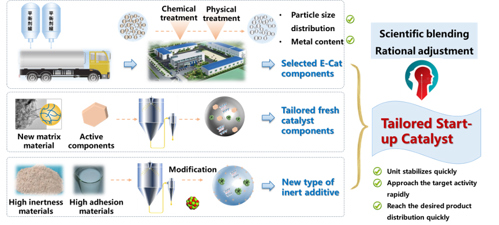
FIG. 1. Technical approach for the TSCa.
INDUSTRIAL APPLICATION OF THE TSCa
The TSCa for a catalytic cracking unitb startup. To rapidly align product distribution and quality with design specifications during startup, the authors’ company’s proprietary deep catalytic cracking unitb unit employed a startup catalyst highly compatible with the designed operating conditions. As the unit is designed to process heavy feedstocks—primarily hydrotreated residue—with propylene as the main target product, the TSCa (2,000 t) was specifically developed to closely match the properties of Ecat under stable operation. The physicochemical properties of the TSCa are presented in TABLE 1.
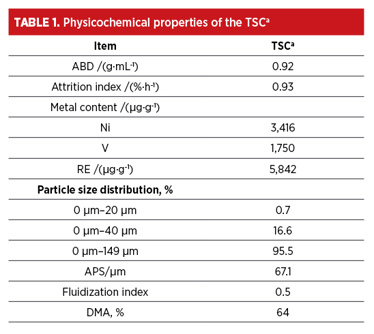
It exhibits excellent physical characteristics, such as apparent bulk density, attrition index and particle size distribution, which facilitate rapid and stable fluidization of the catalyst in the unit. The contents of nickel (Ni) and V are both maintained at low levels, thereby avoiding adverse effects of heavy metals on the catalytic reaction performance. Moreover, its cracking activity is consistent with that of the industrial Ecat, enabling key target products to rapidly approach design yield rates during the initial startup phase and enhancing the overall economic performance of the unit.
The changes in the cracking activity of Ecat and the yield of propylene over the first month of unit operation are shown in FIG. 2. As can be observed, the use of the TSCa enabled Ecat activity to be rapidly matched, resulting in stable catalytic performance. Throughout the first month of operation, the cracking activity was maintained within a narrow range of 60% (± 2%). Just 10 d after startup, the yield of the primary target product, propylene, had essentially reached the guaranteed value, demonstrating the effective industrial application performance of the TSCa. Overall, the application of the custom startup agent contributed to the rapid, stable and efficient operation of the deep catalytic cracking unitb at Yunlong Petrochemical by facilitating optimal fluidization and reaction performance.
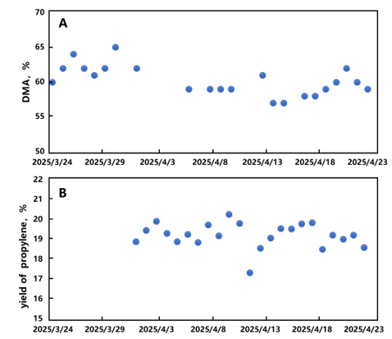
FIG. 2. The cracking activity of Ecat (A); and the yield of propylene (B).
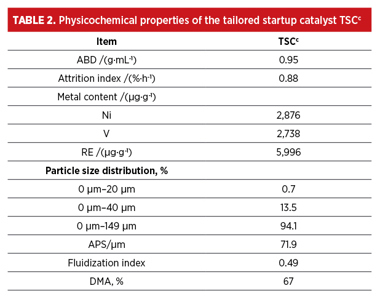
TSCc for an RTCU startup. The RTC process innovatively employs a high-efficiency fast fluidized bed reactor featuring a high-efficiency fast fluidized bed reactor with an inverted cone-shaped, and a gradually expanding diameter structure, which replaces the previous reactor design consisting of a riser plus a dense-phase bed reactor. This new design is characterized by improved catalyst circulation. It is specifically designed to meet the efficient conversion needs of low-quality heavy feedstocks (including intermediate-base and naphthenic-base hydrotreated residue), transforming them into higher economic-value light chemical products such as ethylene and propylene. According to the reactor characteristics and product distribution requirements of the RTCU, TSCc (1,500 t) was developed, with its physicochemical properties shown in TABLE 1.
As can be seen from TABLE 2, TSCc exhibits high resistance to attrition with an attrition index of 0.88 %/hr; low metal content, with mass fractions of Ni, V and rare earth elements being 2,876 μg/g, 2,738 μg/g and 5,996 μg/g, respectively; low fine powder content, with the volume fraction of 0 μm–20 μm and 0 μm–40 μm particles as low as 0.7 % and 13.5 %, respectively; and high cracking activity.
The variation in flue gas dust content during the startup period is shown in FIG. 3 (A). No significant catalyst loss was observed in the two vessels during the first 32 hrs of startup. During the catalyst loading and transfer operations, the dust mass concentration in the flue gas briefly reached 500 mg/m³ but rapidly decreased to approximately 150 mg/m³ within the subsequent 5 hrs. When feed was introduced into the main reactor, the flue gas dust concentration in the regenerator briefly increased again to 300 mg/m³, then dropped rapidly to around 150 mg/m³ within the following 9 hrs, indicating normal fluidization in the regenerator.
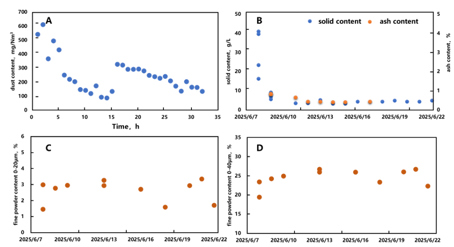
FIG. 3. The variation of dust content in the flue gas (A); the variation of solid content and ash content in the slurry (B); the variation of fine powder content 0 μm–20 μm in Ecat (C); and the variation of fine powder content 0 μm–40 μm in Ecat.
Following startup, as key parameters such as reaction temperature, the pressure and catalyst-to-oil ratio were gradually stabilized, the catalyst circulation was fully established and the efficiency of the cyclones improved. This led to a significant reduction in catalyst loss, and the solid content in the slurry dropped rapidly to the normal range, as shown in FIG. 3 (B). The rapid recovery of slurry solid content and ash to normal operating levels during the initial startup phase represents a critical transition of the deep catalytic cracking unitb from an unsteady to a steady state. This process not only signifies the successful establishment of the catalyst circulation system and the effective operation of the solid removal system, but also lays a solid foundation for the subsequent safe, stable and efficient operation of the unit.
FIG. 3 (C, D) shows the variation in the fine powder content of Ecat in the RTCU. After startup, the content of 0 μm–20 μm and 0 μm–40 μm fines in the regenerated catalyst was maintained within the normal operating range. The fine powder content curve remained essentially flat, without any noticeable "spikes." This indicates that TSCc is highly compatible with the unit's operating conditions in terms of strength, particle size distribution and activity, thereby successfully avoiding the risks of a sharp increase in fine particles and potential catalyst loss associated with conventional startup methods.
TSCd for an MIP-CGP unit startup. Based on the process characteristics and product distribution requirements of the MIP-cleaner gasoline and propylene (CGP) unit, another TSCd was developed. Its catalytic activity closely matches the expected activity level of Ecat in the target unit, while its excellent physicochemical properties (e.g., apparent bulk density, specific surface area, metal content, particle size distribution) are fully consistent with the unit's technical specifications. This ensures a smooth and highly efficient startup for the MIP-CGP catalytic cracking unitb, enabling operational indicators and product yields to rapidly align with the process design after commissioning, thereby guaranteeing economic benefits. The physicochemical properties of TSCd are listed in TABLE 3.
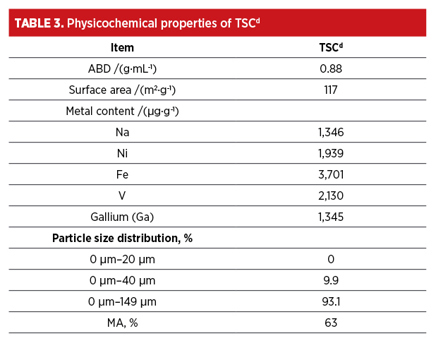
As shown in TABLE 3, TSCd possesses superior physical parameters: the mass fractions of sodium (Na), Ni, iron (Fe), V and calcium are 1,346 μg/g, 1,939 μg/g, 3,701 μg/g, 2,130 μg/g and 1,345 μg/g, respectively. Regarding particle size distribution, TSCd has a low content of fine particles, with the volume fraction of 0 μm–20 μm and 0 μm–40 μm particles being minimal. With a cracking activity of 63%, it ensures an efficient and stable startup operation for the unit.
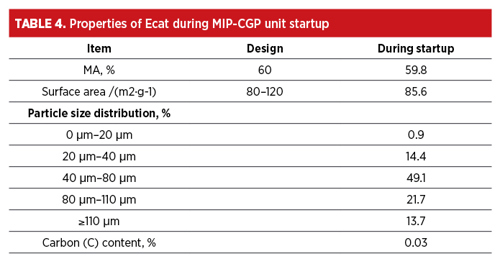
The properties of Ecat during the startup period are presented in TABLE 4. During this period, the catalyst exhibited a cracking activity of 59.8% and a specific surface area of 85.6 m²/g, both meeting the design specifications. Furthermore, the particle size distribution of Ecat fell within the normal range. The main operating parameters of the unit were also largely consistent with the design values during startup.
The impact of TSCd on the product distribution of the catalytic cracking process was evaluated. During startup, the combined yield of gasoline and liquefied petroleum gas (LPG) reached 62.3%, exceeding the design value of 61%. Concurrently, the slurry yield was 5.4% (below the design value of 6.1%), and the coke yield was 8.1% (below the design value of 8.9%). This favorable product distribution demonstrates the excellent physicochemical properties of TSCd and its high compatibility with the MIP-CGP unit. The application of this custom agent enabled a highly efficient and stable startup, allowing both operating parameters and product distribution to rapidly approach the unit's design targets. All key product qualities consistently met specifications from the initial phase of operation.
Moreover, during the startup with TSCd, critical indicators such as the solid content in the slurry, the gas velocity in the vortex quick separator (VQS) cyclones and the particulate concentration at the outlet of the tertiary cyclones all remained within normal ranges. Stable fluidization was maintained in both the reactor and regenerator, with no adverse effects observed on the performance of the primary catalytic cracking catalyst or on product quality. The application results clearly indicate a significant positive outcome.
TSCe for replenishment during abnormal catalyst loss. The unit employed the tailored startup catalyst TSCe, which functions as a system displacement agent, to rapidly replace Ecat with high fine content within the system. This measure effectively controlled the content of 0 μm–40 μm fines in the regenerated catalyst and reduced slurry ash content, thereby ensuring the long cycle, safe and efficient operation of the unit. The technical specifications of TSCe are listed in TABLE 5, indicating its low fine powder content, low levels of contaminant metals and low attrition index.
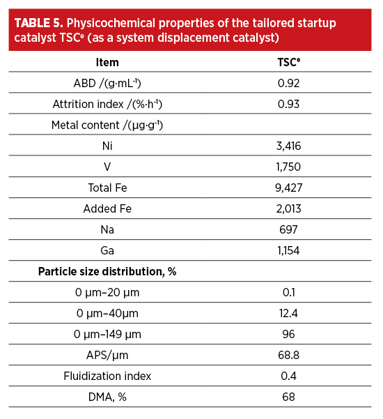
FIG. 4 illustrates the changes in slurry solid content, slurry ash content and the content of 0 μm–20 μm and 0 μm–40 μm fines in Ecat following the application of TSCe. It can be observed that the rapid displacement operation using the TSC effectively mitigated the operational challenges of high fine powder levels and elevated slurry ash in the unit. The slurry ash content decreased promptly, and the fine particle content in Ecat also showed a significant reduction, demonstrating notable application effectiveness and contributing to the unit's long-cycle, safe and high-efficiency operation.
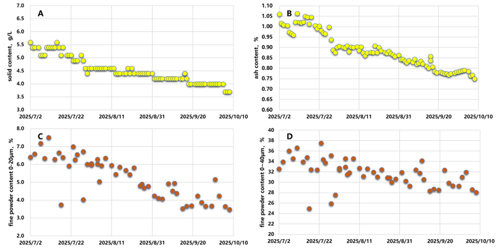
FIG. 4. The variation of solid content in the slurry (A); the variation of ash content in the slurry (B); the variation of fine powder content 0 μm–20 μm in Ecat (C); and the variation of fine powder content 0 μm–40 μm in Ecat.
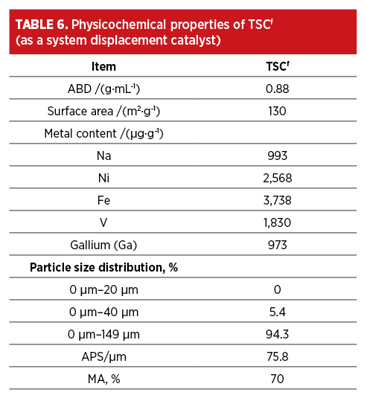
TSCf for a rapid replacement after Ecat poisoning. The feedstock processed by this catalytic cracking unit exhibits a high V content, resulting in a persistent concentration of > 7,000 mg/kg of V on Ecat. This adversely affected the unit's product distribution. To maintain catalyst activity and selectivity, the addition rate of fresh catalyst was increased to enhance catalyst replacement. This led to a high unit consumption of fresh catalyst, elevating both auxiliary material costs and coke yield, which significantly impaired the overall economic performance of the unit. To ensure efficient and stable operation, reduce coke formation, lower catalyst consumption, increase unit throughput and improve product distribution, the authors’ company’s TSCf was applied to displace the high-metal-content catalyst within the system and reduce fresh catalyst make-up.
The physicochemical properties of TSCf are listed in TABLE 6. It is characterized by low metal content, with a V concentration of only 1,830 mg/kg, low fine powder content and high catalytic activity. These properties are conducive to reducing the heavy metal contamination level on Ecat and mitigating the adverse effects associated with the high heavy metal content in the feedstock.
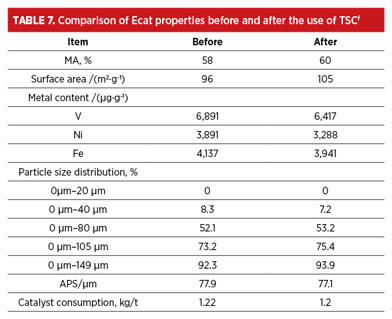
 A comparison of Ecat properties in TABLE 7 indicates that the particle size distribution remained largely consistent before and after the application of TSCf, suggesting no adverse impact on unit fluidization. Following the implementation of TSCf, the catalyst consumption decreased from 1.22 kg/t to 1.20 kg/t. Concurrently, key properties of the regenerated catalyst showed marked improvement: the V content dropped from 6,891 mg/kg to 6,417 mg/kg, the catalytic activity increased from 58 to 60, and the specific surface area increased from 96 m²/g to 105 m²/g. These results demonstrate a significant enhancement in the quality of the catalyst inventory within the system.
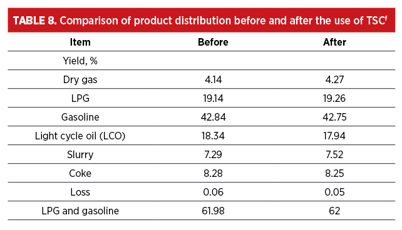
As can be seen from TABLE 8, the application of TSCf led to an improved distribution of LPG. Specifically, compared to the pre-application baseline, the LPG yield increased by 0.12 wt%, while the gasoline yield decreased by 0.1 wt%. The combined yield of LPG and gasoline showed a marginal increase of 0.02 wt%. The diesel yield decreased by 0.47 wt%, and the coke yield was reduced by 0.03 wt%. The total yield of light products remained stable, which aligns with the core objective of enhancing the economic performance of the unit.
Takeaways. Based on the specific process characteristics and product distribution requirements of the target unit, the authors’ company developed the TSC series. The TSC series exhibits a high degree of compatibility with the target unit in terms of both physical properties and catalytic performance. They are suitable for a wide range of industrial applications, including the startup of new units, unit commissioning after shutdown and maintenance, rapid replacement of poisoned Ecat, and catalyst replenishment following abnormal catalyst loss. Furthermore, their application facilitates the high-value utilization of spent catalyst.
NOTES
a TSC-D1
b DCC-Plus
c TSC-R1
d TSC-F1
e TSC-R2
f TSC-F2
The Authors

Han Lei is an Associate Researcher at Sinopec Research Institute of Petroleum Processing Co. Ltd. (RIPP). She has published more than 20 papers in domestic and foreign journals and applied for more than 70 domestic and foreign invention patents, including more than 50 authorized invention patents. Dr. Lei’s main research interests are the basic research and industrial application of new catalytic materials and catalytic cracking catalysts, and the whole lifecycle management of catalysts.

Chen Yan is an Associate Researcher at RIPP. She has published more than 15 papers in domestic and international journals, filed more than 40 domestic and foreign invention patents (of which more than 20 have been granted), and formulated four industrial standards. Dr. Chen’s main research focuses cover the development of anti-metal catalytic cracking catalysts and the full lifecycle management of spent catalysts.

Song Haitao is a Professor of chemical technology and Director of the FCC catalysts department at RIPP. His research areas include FCC/DCC catalysts, catalytic additives, ammonia decomposition and environmental catalysis. Dr. Song has published more than 30 papers and been authorized more than 50 patents. The catalysts and additives have been applied on more than 60 units.


Comments