

Pertamina and CRecTech sign MoU to explore pilot biogas-to-biomethanol facility in SEZ, Indonesia
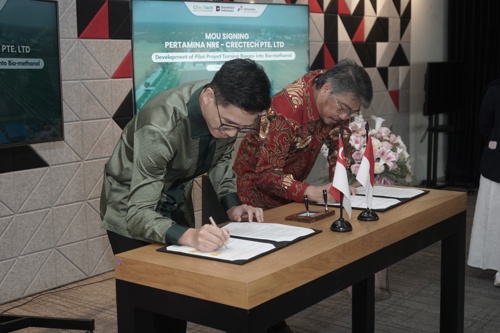
Pertamina New & Renewable Energy (Pertamina NRE) continues to strengthen its commitment to expanding its renewable energy portfolio, as reflected in the signing of a Memorandum of Understanding (MoU) with CRecTech Pte. Ltd. (CRecTech). The agreement focuses on exploring the development of a pilot biogas-to-biomethanol facility in the Sei Mangkei Special Economic Zone (SEZ) in Sumatra, Indonesia.
CRecTech Pte. Ltd. is a Singapore-based clean technology company that converts carbon-based gases into high-value chemicals and fuels through its proprietary CRecREF™ catalytic technology, with a focus on supporting decarbonization and advancing green chemical solutions.
This MoU marks a strategic step toward optimizing the utilization of domestic renewable energy resources, particularly biogas, which holds significant potential in Indonesia. The initiative not only opens opportunities for the development of next-generation green fuels but also represents a key milestone in strengthening Indonesia’s role within the global clean energy supply chain. In addition, biomethanol development has the potential to support decarbonization in the maritime sector while creating added economic value from local resources.
The CEO of Pertamina NRE, John Anis, stated that this collaboration forms part of the company’s strategy to accelerate the development of clean energy based on local resources.
“This collaboration represents a concrete step by Pertamina NRE in accelerating the utilization of biogas into higher value-added products such as biomethanol. Indonesia holds significant potential, both in terms of market demand and feedstock availability—particularly from palm oil waste, which has yet to be fully optimized. Through our partnership with CRecTech and its innovative technology, we are confident in building a competitive and sustainable green fuel value chain. Moving forward, we hope this initiative will not stop at the pilot stage but can be scaled up to a larger commercial level, delivering tangible impact on the development of Indonesia’s green energy ecosystem,” said John.
Through this partnership, Pertamina NRE and CRecTech will conduct a joint study to evaluate the feasibility of developing a pilot biogas-to-biomethanol facility in the Sei Mangkei SEZ. Should the study yield positive results, the collaboration will proceed with the deployment of CRecTech’s CRecREF™ catalytic technology at the Sei Mangkei Biogas Power Plant.
“CRecTech’s CRecREF™ technology is specifically designed for applications like this—converting low-quality biogas streams into high-value green chemicals directly at the production site, without the need for large-scale investments typically required by conventional methanol plants. Indonesia has immense biogas potential, and Pertamina NRE is the ideal partner to transform this resource advantage into a commercially viable biomethanol supply. We are pleased to formalize this collaboration and look forward to demonstrating its potential in Sei Mangkei,” said Kang Hui Lim, CEO of CRecTech.
This MoU is also driven by the accelerating global transition from conventional marine fuels to more environmentally friendly alternatives, particularly in the shipping sector, which is shifting toward low-carbon fuels. Indonesia itself possesses significant biogas potential, especially from the palm oil industry through the processing of Palm Oil Mill Effluent (POME). Pertamina NRE has identified several locations within its portfolio, including Sei Mangkei, with large-scale feedstock availability.
Looking ahead, the development of an integrated biogas-to-biomethanol value chain is expected to position the Sei Mangkei SEZ as a green fuel production hub in Indonesia. This initiative not only strengthens Indonesia’s contribution to global emission reduction efforts but also delivers tangible economic benefits through job creation, increased investment, and the optimization of domestic renewable energy utilization.


Comments