


BASF introduces BDO, THF, PolyTHF and NMP product variants with reduced product carbon footprint
- Reduced product carbon footprint (rPCF) achieved through low emission feedstocks and utilities
- Minimum 10 percent PCF reduction compared to the corresponding BASF standard product with unchanged product performance
- Enables customers to lower emissions in their value chains without altering formulations or processes
BASF’s Intermediates division has introduced new product variants with a reduced product carbon footprint (rPCF) for butanediol (BDO), tetrahydrofuran (THF), polytetrahydrofuran (PolyTHF®), and N-methylpyrrolidone (NMP) produced at its Verbund site in Ludwigshafen, Germany. From this site, the products can be supplied to customers worldwide and help expand the division’s new rPCF product category, which is currently under development.
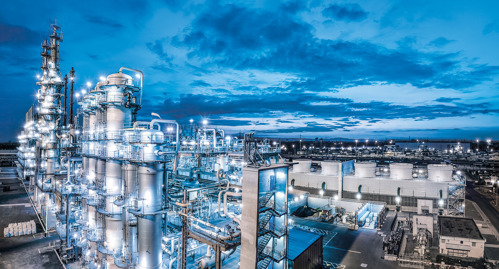
The reduced product carbon footprint is achieved through low emission feedstocks and utilities at the Ludwigshafen site. As a result, the rPCF variants offer a lower carbon footprint of at least 10 percent compared to the corresponding standard products manufactured in Ludwigshafen.
Supporting customers’ transformation toward lower‑carbon materials. By introducing rPCF variants for BDO, THF, PolyTHF and NMP, BASF expands its portfolio of intermediates with a reduced product carbon footprint and supports customers in taking another step in reducing their Scope 3 CO2 emissions. Customers serving different segments like automotive, pharmaceuticals, electronics, textile and consumer goods can now benefit from raw materials with a reduced carbon footprint without the need to adapt existing formulations or production processes.
Essential raw materials in many value chains. BDO is used to produce PolyTHF and to manufacture THF and gamma‑butyrolactone (GBL) for pharmaceutical applications. It is also a starting material for NMP and polybutylene terephthalate (PBT). BASF is a leading global producer of BDO and its derivatives, with two production plants and an annual capacity of 350,000 metric tons.
PolyTHF is mainly used to produce elastic spandex and elastane fibers for textiles such as swimwear, sportswear, underwear, shirts and stretch jeans. It also serves as a key building block for thermoplastic polyurethanes (TPU) used in abrasion resistant hoses, films and cable sheathing, especially for automotive applications. Other uses include polyetheresters, polyetheramides and cast elastomers, such as wheels for skateboards and inline skates. With three production plants in Europe, North America and Asia Pacific and a total capacity of 250,000 metric tons per year, BASF is one of the world’s leading suppliers of PolyTHF, which is a BASF brand in many countries. NMP is an aprotic, highly polar organic solvent used across many industries. Its applications range from pharmaceutical production and the manufacture of specialized filtration membranes to the processing of lithium‑ion batteries. It also plays a role in creating coatings, inks and resins, and is used in agricultural formulations as well as certain oil and gas extraction processes.

Comments