


February 2026
Sustainability and The Energy Transition
Too small to be viable? SMRs and their potential to economy-wide decarbonization—Part 2
Small modular reactors (SMRs) are nuclear fission reactors that generate up to 300 megawatts electric (MWe) per unit, emphasizing modularization, factory fabrication and enhanced safety features. The SMR concept aims to address challenges faced by traditional large nuclear plants, including high costs and long construction times.
Most SMRs currently proposed use light-water technology, benefiting from the experience of existing pressurized and boiling water reactors. While several designs have advanced to licensing and construction stages, commercial deployment remains limited, with only a few first-of-a-kind SMR projects expected to begin by the mid-2020s, often relying on government funding or support from state utilities
Part 1 appeared in the January issue, and Part 2 here moves beyond technical feasibility to executive decision-making, comparing SMRs with renewables across desalination, synthetic fuels and off-grid power to determine where SMRs can deliver benefits. It also presents a practical framework to guide investment choices, risk management and long-term strategic planning.
Desalination and water supply: SMR-powered desalination vs. renewables + storage. Desalination is energy-intensive: modern reverse osmosis (RO) plants consume on the order of 3 kWh–5 kWh of electricity per cubic meter (m3) of water for seawater RO, and possibly up to ~25 kWh/ m3 including pumping and treatment. Today, most large desalination plants are powered by fossil fuels or grid electricity. In fact, nuclear reactor power to desalination units has been demonstrated—one example is the BN-350 fast reactor in Kazakhstan that produced both power and up to 80,000 m3/d of potable water. The cogeneration plant was designed for 1,000 megawatts of thermal (heat) power (MWt), but operated at up to 750 MWt. Research and literature generally conclude that nuclear desalination is technically feasible. SMRs, with their smaller size, could be particularly well-suited for decentralized desalination projects. For example, a 100-MWe SMR on a coast could dedicate a portion of its output (some 20 MW–30 MW) to a large RO plant producing ~100,000 m3/d, enough to supply 100,000 households.
Renewable energy, especially solar, is also being eyed to power desalination. One challenge is that water demand is continuous. Large cities need desalinated water 24/7, so either you oversize the solar and store excess water in reservoirs, or use batteries to run at night, or have backup power. Storing water is, in some ways, simpler than storing electricity. However, water storage for an entire city for a week of cloudy weather would require massive infrastructure. Thus, many renewable desalination concepts still include a fossil backup (or grid connection) for reliability. A fully off-grid renewable desalination facility with batteries could be costly and complex. SMR-powered desalination provides steady output and could potentially simplify operations.
Energy cost is a big part of water cost. If an SMR provides electricity at, say, $0.07/kWh, the energy cost per m3 for RO might be ~$0.21 (at 3 kWh/ m3)—that is competitive with or better than using grid power in many regions. If solar at $0.02/kWh is available, it is cheaper per kWh, but the costs in storage or overbuild must be factored in. Hybrid schemes might also emerge. An SMR could provide baseload power to a desalination plant covering night-time and winter needs, while solar or wind feeds the grid/plant in daytime, thereby minimizing fuel costs and still guaranteeing water supply. Notably, nuclear desalination fits well in countries with nuclear programs.
The differentiator is the ongoing energy and carbon costs. If a region already has cheap renewables and some existing gas backup, they might find renewable desalination a lower-cost path. But if fuel is expensive or carbon-constrained, an SMR running at high capacity could deliver a stable water cost. Additionally, nuclear desalination could qualify for green financing or earn premium for reliability (drought-proof water).
Some promotional literature touts SMRs as ideal for remote islands’ water supply or for climate-change-driven drought relief. In reality, renewables plus storage have made more headway in off-grid desalination so far, because solar and wind are readily available and modular, whereas SMRs are still in development. For a company or municipality considering desalination, an SMR is only viable if:
- They are open to developing a nuclear project.
- Long-term water demand justifies a > 40-yrs asset.
- Alternatives (renewables, efficiency, importing water) are insufficient.
Meanwhile, smaller-scale needs will be met with simpler setups like solar-driven RO with backup gensets. Overall, SMRs could make desalination truly carbon-free at large scale, but expect the first few examples as flagship projects in nuclear-friendly, water-scarce nations around the 2030s or 2040s.
Transportation and synthetic fuels: SMRs for eFuels vs. biofuels and green H2. Decarbonizing transport, especially aviation and shipping, may require high energy density (energy per volume)—e.g., synthetic fuels (eFuels)—due to fuel storage space and weight limitations.
Producing eFuels like synthetic diesel, jet fuel or methanol involves combining H2 with carbon (usually CO2 captured from air or industrial sources) using chemical processes (Fischer-Tropsch synthesis, methanol synthesis, etc.). Processes need two main inputs that are a source of H2 and a lot of energy (electricity and heat) to drive reactions and refining. SMRs could step in by providing a continuous flow of low-carbon electricity and heat for eFuel production. In a nuclear-powered eFuels plant, the SMR would produce H2 (via electrolysis or high-temperature methods, as discussed) and also supply process heat for reactors and separations.
A recent demonstration project funded by the U.S. Department of Energy (DOE) will use electricity and steam from Arizona’s Palo Verde nuclear plant to produce H2, convert CO2 + H2 to syngas, and then run Fischer-Tropsch to create synthetic hydrocarbons (power-to-fuels). The allure is that an SMR (or large reactor) could operate at high-capacity factor, making fuels continuously, which is important for facility economics. Fuel synthesis plants are capital-intensive, so steady operation is key. With purely intermittent power, a Fischer-Tropsch plant would sit idle much of the time unless massively overbuilt renewable/storage is available. Nuclear ensures a high utilization of the expensive chemical equipment.
The main alternatives for low-carbon liquid fuels are biofuels [e.g., ethanol, biodiesel, sustainable aviation fuel (SAF) from crop or waste] and electrofuels (eFuels from green electricity). Scaling biofuels to cover aviation/shipping would demand huge land areas and could conflict with food production and ecosystems. Electrofuels, on the other hand, can in principle be scaled if enough clean energy is available; however, they are currently very expensive. The cost is driven by the cost of H2 and the energy needed for CO₂ capture and fuel synthesis. However, any synthetic fuel, whether powered by nuclear or solar, will be much more energy-intensive and costlier than present fossil fuels. This will likely require strong policy support (carbon pricing, fuel mandates for aviation/shipping) to create a market. SMRs would simply be another energy source to drive the conversion. If renewable electricity becomes extremely abundant and cheap, it might outcompete nuclear for eFuels production in many places.
Another perspective is using micro-SMRs to directly power transport nodes instead of fuel factories. Examples include installing an SMR at a major port to provide clean shore power and generate eFuels for ships, or powering a synthetic kerosene plant at an airport to supply carbon-neutral jet fuel onsite.
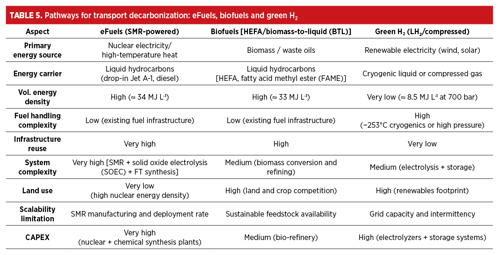
The competition (biofuels, green eFuels) depends on regional resources. Nuclear could be one major source of the required clean H2 and process energy to manufacture those fuels at scale. Conversely, if direct electrification (batteries for trucks/short-haul planes, etc.) reduce liquid fuel needs, the market for synthetic fuels might remain limited to long-haul aviation and certain chemicals (TABLE 5).
Data centers, remote communities and off-grid applications: SMRs vs. renewables + storage. One area where SMRs could shine is locations that live on off-grid power, such as small arctic communities, remote mining operations and isolated military bases. Diesel-based systems face extremely high energy costs due to fuel transport challenges: electricity from diesel can cost 5–10x more than grid power. Fuel delivery can be seasonal (by ice road or barge), and supply disruptions are a real risk in harsh climates. Fresh micro-SMRs (< 50 MWe) could power a site for > 10 yrs with no refueling logistics. According to the Nuclear Energy Institute, microreactors could cut the cost of electricity in remote communities by 30% or more relative to diesel.
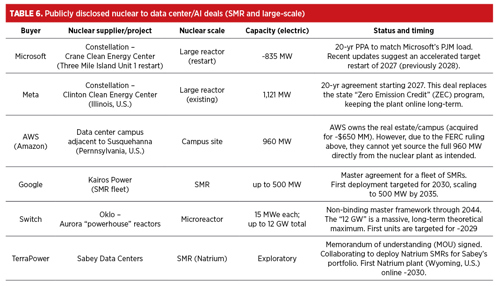
Data centers are energy-hungry and demand nearly 100% uptime. Currently, they rely on dual grid feeds plus backup diesel generators and UPS systems. Some operators are investigating SMRs to provide reliable, emissions-free power onsite (TABLE 6). The idea of a “nuclear battery” powering a data center remains an idea. While no data center has announced an SMR yet, companies like Microsoft have shown interest through hires and research into microreactors. Another remote application is telecom or observation outposts, where microreactors could replace large solar and battery setups currently used for reliability.
For many remote needs, renewables with batteries are the immediate competitor to diesel. However, renewables alone often cannot cover the full load year-round in harsh climates. A micro-SMR could potentially provide a reliable baseload, with renewables picking up part of the load when available, or a hybrid that minimizes fuel use. As always, financing and scale production will determine whether those costs come down.
For market potential, remote and off-grid applications might be the earliest commercial market for SMRs. The total market size is not huge in terms of MWe, but it is an important demonstration market.
Investment decision framework for SMRs. For companies and stakeholders evaluating SMRs as part of their decarbonization strategy, it is essential to apply a structured decision framework. SMRs are a promising but complex solution. A guide to making an informed decision is discussed in the seven points below.
- What’s the energy service you actually need?—Clarify what you need from an SMR. Is it electricity, process heat, H2, or a mix? How much power/heat is required, and must it be 24/7? Determine the specific role (e.g., provide 100 MW of steam to a chemical plant, or supply 50 MWe to a remote mine). This will guide which SMR type/size is even applicable. Some designs target electricity only, others cogeneration. Match the reactor to your use case.
- Screen candidates by “deployability” [not just technology readiness level (TRL)]—Define the TRL of SMRs that meet your needs. Are there designs at commercial stage, or are they still on the drawing board? Check licensing status: has the reactor design been approved by a regulator or is it still experimental? Also, assess the vendor’s track record and the status of any demonstration plants. If your decarbonization timeline requires action by 2030, betting on a not-yet-built SMR introduces schedule risk. You may need a backup plan or to start with an interim solution (like electric boilers or H2 from renewables) until the SMR is online.
- Compare economics against alternatives (apples-to-apples)—Perform a techno-economic analysis for your specific case. Compare the levelized cost of energy/heat/H2 from the SMR (including capital, operations and maintenance, fuel, decommissioning provisions) against alternatives like renewables plus storage, fossil fuel with carbon capture and storage (CCS) or other emerging technology. Be sure to include carbon prices or emissions costs in the comparison, as SMRs avoid those. Also consider subsidiary value: a nuclear plant’s firm capacity might have value for grid reliability or resiliency that is not captured in a simple levelized cost of electricity (LCOE). Conversely, factor in costs for nuclear-specific requirements (security, insurance, licensing overhead). Because vendor cost estimates can be optimistic, conduct sensitivity analysis on key inputs (capital cost could be ±30%, construction time ±yrs). If possible, use real data from pilot projects or studies. In some scenarios, you may find the SMR is not the least-cost option unless you credit the reliability and emissions benefits appropriately. Identify any government incentives (grants, tax credits, loan guarantees) that may significantly improve the economics of the SMR. These can tilt the decision.
- Regulatory, legal and siting feasibility—Examine the regulatory environment in your region. Is nuclear energy legally permitted and socially accepted? Some countries (and companies) have policies against nuclear power that would make SMR deployment impractical regardless of merits. If it is allowed, how lengthy is the licensing process and does your organization have the expertise to navigate it? Engage early with regulators to understand requirements for onsite safety, security and emergency planning (especially if planning an SMR at an industrial facility or near a populated area for district heating). The site is crucial: do you have a suitable location for the SMR with geological stability, cooling water (if needed) and a buffer zone? For remote sites, consider transport of the module and refueling logistics (will fuel be shipped by air, road?). Basically, ensure there are no “showstopper” regulatory or site issues that would derail the project late.
- Choose an execution and partnership model that matches your capabilities—Given the complexity of nuclear projects, a company will rarely go it alone. Identify potential partners: reactor vendors, engineering/construction firms, utilities or energy companies familiar with nuclear operations, and possibly government agencies. An investment consortium can spread cost and risk. For example, an industrial plant might partner with a utility that will own/operate the SMR on the plant site, so each can focus on their expertise. Explore government co-funding or risk-sharing mechanisms: many first SMRs are happening with significant public investment due to their strategic importance. The investment decision should account for the business model: will you buy power/heat from an SMR owned by someone else [power purchase agreement (PPA) or heat purchase agreement], or will you invest equity in the SMR project? The latter gives more control and potentially profit, but also more risk. Ensure that the project structure aligns with your company’s risk tolerance and core competencies.
- Address “expectation vs. reality”early—Internally, build a realistic understanding of what adopting an SMR entails. Temper any hype with lessons learned from past projects. For instance, do not assume overnight factory construction until it has been demonstrated, and plan for possible delays in first-of-a-kind deployment. Be aware of public perception issues: even if your calculations show SMR is best, local opposition could delay or halt a project. Have a stakeholder engagement plan: educate the community, workers and investors on the safety and benefits of the SMR, and how risks will be managed. It is wise to have ‘offramps’ in your investment plan (e.g., decision gates where, if the SMR project is not meeting milestones or costs escalate too much, you pivot to an alternative solution). This flexibility is important given the uncertainties. Essentially, hope for the best (SMR fulfills its promise of reliable, clean energy at competitive cost) but plan for the possibility of setbacks (licensing taking longer, costs coming in higher). Managing expectations will maintain credibility and make it easier to continue with the project through challenges.
- Align withlong-term strategy and capture co-benefits—Fit the SMR decision into your long-term decarbonization and business strategy. An SMR is a 40 yrs–60 yrs asset: does your company plan that far ahead, and will the energy demand persist? If your industry is shrinking or could be disrupted, a long-lived asset might become a liability. On the other hand, an SMR could open new revenue streams (selling excess power or H2 to neighbors, providing ancillary grid services). Consider the broader value. For example, a chemical company investing in an SMR for process heat might also use it to produce H2 for sale, diversify into synthetic fuels, or attract other industries to co-locate (forming a clean energy industrial cluster). These co-benefits can improve the investment case. Also, anticipate future regulatory changes: owning a nuclear plant might eventually earn credits in a carbon-constrained world or allow you to meet ESG targets more convincingly, which has brand and market value. In sum, view the SMR not just as a replacement for a boiler or power plant, but as a strategic asset that could differentiate your company in a decarbonized economy—if you are prepared to navigate the initial hurdles.
Takeaways. Adopting an SMR is a considerable undertaking, but with a systematic evaluation of needs, technology, economics and risk mitigation, companies can determine whether it is the right fit. In sectors with limited alternatives (e.g., high-temperature industries, remote energy, constant large-scale H2 demand), the case for SMRs can be strong, providing a unique competitive edge in achieving deep decarbonization. In other areas where wind, solar and batteries suffice, an SMR might be hard to justify based on cost or speed of deployment. The decision framework above helps cut through hype and focus on practical, data-driven factors. As SMRs transition from concept to reality in the coming decade, staying informed on pilot project outcomes will be crucial. Today’s expectations will be reshaped by the first movers. Companies that do their due diligence now will be ready to seize the opportunity (or wisely choose alternatives) as the landscape becomes clearer.
The Author

Smith Wattanasoponvanij is an independent consultant with more than 10 yrs of experience in technology development and process engineering across the petrochemical and energy-transition landscape. His work spans business and market studies, technology research, process R&D and design, and feasibility studies, with practical experience in scaling technologies from laboratory to pilot and commercial deployment. He also supports organizations through fast-cycle technology development, cross-functional R&D-to-business alignment, and structured R&D methods to accelerate time-to-market.


Comments