


February 2026
Digital Technologies
How AI agents can finally close industry’s most persistent blind spot
Due to aging infrastructure and stricter regulations, asset owners have made significant investments in their plants, and more are on the way. In a 2025 industry survey,1 63% of industrial decision-makers plan to boost spending in various pathways to improve uptime, reliability and safety in their facilities.1
Every few years, the hydrocarbon processing industry sees another transformative solution to make sites safer and better. The most recent include digital twins, predictive analytics, and autonomous inspections and operations, among others. Each innovation seems to bring the industry closer to a refinery where every step is continually optimized—i.e., a self-optimizing plant.
Yet, for all the progress, one truth has never changed: too many of the most important decisions are made without understanding the physical state of the asset itself. Process data has become faster, richer and more actionable. However, the structural health of the plant—the steel that actually carries the load, pressure and corrosion—remains largely unknowable in real time.
This creates what the author has called the “structural void”: a gap in real-time decision-making where the physical asset itself has no voice. A better feed blend, a more aggressive cut point or a temporary rate increase would be proposed, only for the implementation to stall because validating the structural impact takes too long. Traditional finite element analysis (FEA) can be used to address this, but it was never designed for high-frequency operational decisions. Another solution to overcome this structural void is asset performance management (APM). However, as industry analysts confirm, traditional APM has historically lacked the real-time, physics-based approach to address the structural integrity of fixed equipment.2
This article will detail how artificial intelligence (AI) agents can finally close this integrity blind spot and how it can be implemented, as well as a few example scenarios to demonstrate the significant value of AI agents in the oil and gas industry.
How AI agents connect the two disconnected worlds of process and integrity. Anyone who has spent time in a refinery will know this disconnect very well. On the process side, the tools used are incredibly advanced. Advanced process controls (APC), real-time optimization and simulation are sleek and modern, but step over into the integrity realm, and the workflow and activities can be dated back to the 1980s.
Periodic inspections, manual measurements and integrity assessments can take days or weeks. Additionally, plant personnel must enter hazardous spaces to gather the data required to make an informed decision. While inspection techniques are advancing, the steps to achieve a conclusion were never built for operational tempo.
The results are predictable: opportunities get missed, risks accumulate quietly, and potential gains in throughput or energy efficiency remain untapped because no one can quickly answer the most basic question: Is the asset healthy enough to run the way we want to run it? With 80% of refinery assets being made from pressurized steel,3 that is millions of dollars in untapped potential.
To match that operational speed, the integrity team compensates with conservative estimates, rules of thumb, procedural safeguards, etc. These are necessary, but ultimately personnel are still making an educated guess about the true integrity state of the asset. Guesswork and self-optimization do not mix.
Currently, there is one shining example of how this structural void has been narrowed: Shell Qatar’s Pearl gas-to-liquids (GTL) plant. The plant—winner of the 2025 World Economic Forum’s Lighthouse Award4—demonstrates the powerful gains of digital transformation, deploying more than 45 Fourth Industrial Revolution solutions, including AI for Structural Integrity (AI4SI), to achieve:
- 9% higher throughput
- 99% reliability
- 7% emissions reduction
- Up to a 50% extension of equipment life.
These results highlight the compounding value effect: optimizing whole-site decisions, not isolated tasks, unlocks significant improvements.
This kind of achievement requires AI agents that understand the full operational context, grounded in real Internet of Things (IoT) data and engineering-grade physics. Early deployment of agentic AI has been isolated and singular—e.g., a process optimizer agent that focuses on maximizing flowrates or a vibration analyst agent that monitors bearing frequencies, among others. Each performs well individually, but without shared context, they recreate the same organizational silos that process and integrity teams had, just at a more rapid pace. Circling back to the example above: A process optimizer may increase pump speed to boost throughput, while the vibration analyst is already flagging a Stage 2 bearing fault. The result is automated misalignment. Without a unified operational view, agents cannot make safe tradeoffs.
For modern industrial AI agents to function as intelligent co-pilots, they must be built on three layers (FIG. 1):
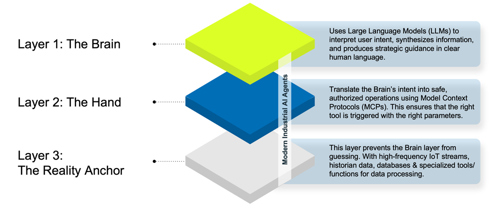
FIG. 1. The three layers of a modern industrial AI agent.
- Layer 1, the Brain: Uses large language models (LLMs) to interpret user intent, synthesizes information and produces strategic guidance in clear human language.
- Layer 2, the Hand: Translates the brain’s intent into safe, authorized operations using model context protocols. This ensures that the right tool is triggered with the right parameters.
- Layer 3, the Reality Anchor: This layer grounds the brain in factual evidence. With high-frequency IoT streams, historian data, engineering databases, and specialized tools or programming functions for data processing, this layer prevents the Brain layer from guessing.
Orchestration: Turning a specialist agentic AI into a harmonic team. While modern AI agents must be built with a three-layer architecture in mind, they are still singular agents. The real breakthrough comes when these specialized agents operate under a shared orchestration layer that adapts to the asset’s true condition.
Like a real-life orchestra, the “musicians” are various AI agents that “play” together in harmony. A typical structure is detailed in TABLE 1.
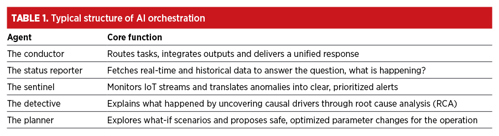
The following are a few example scenarios to determine how this orchestra would play in practice.
Scenario 1: Remote health check. A field engineer requests a quick update from the assets. The conductor queries the status reporter and returns with a concise, accurate health summary in seconds, based on historical data and real-time sensor data. This enables quick decision-making by the engineer from any location.
Scenario 2: Proactive warning. The sentinel detects a hotspot exceeding the maximum tolerances of the asset. It generates a plain-English warning, and the conductor pushes it to the right engineer before failure occurs. This enables rapid intervention before catastrophic failure, preserving asset life and minimizing downtime.
Scenario 3: Performance optimization. The process team notices a downward trend in the throughput report. They query the system to fix the issue. The conductor coordinates two specialists: the detective and the planner. The detective uses RCA to identify causal drivers (such as feedstock variance), while the planner proposes new operational settings, based on the data from the detective and its own reality anchor, for the process and integrity teams to review and implement (FIG. 2).
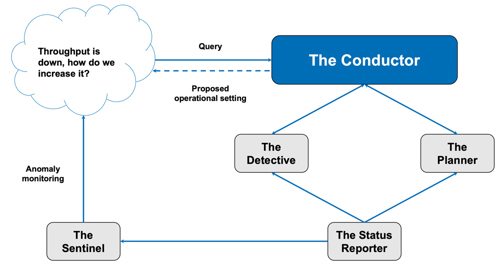
FIG. 2. Orchestration of AI agents to increase plant throughput.
Through these three examples, one can see how this powerful orchestration layer is key to this transformation. It replaces slow, sequential decision chains with a coordinated system that adapts continuously, based on the true physical condition of the plant.
The missing puzzle piece: Physics-based certainty. While anomaly detection and root-cause inference can rely on statistical or machine-learning models, optimization demands rigorous engineering validation. This means that the planner cannot guess a safety margin. It must have a detailed fatigue analysis grounding its output.
Circling back to the two methods mentioned in the beginning of this article, for decades FEA has been the gold standard for such fatigue analyses. However, as mentioned earlier, conventional FEA is computationally intensive. Simulations often require hours or even days due to the amount of differential equations that must be solved, and its "one-shot" nature means the entire modeling and meshing process must be repeated each time a design or parameter is changed. An AI agent simply cannot function if its core analysis tool has a turnaround time measured in days.1,5
To match the speed of operations and AI agents, ensuring physics-based simulation would require a new method of FEA. One such method is reduced basis FEA (RB-FEA). RB-FEA is a powerful model order reduction technique that builds on a key insight: the high-dimensional solution space used in conventional FEA is much larger than necessary. The actual solutions to a parameterized problem exist on a much lower-dimensional "solution manifold."5
RB-FEA works in two stages. First, in a one-time, computationally intensive offline stage, the system performs a series of full FEA solves called "snapshots" to map out this solution manifold. Then, in the online stage, it uses this pre-computed data to solve any new set of parameters almost instantly. This reduces a linear algebraic system of millions of degrees of freedom, enabling simulation speeds that are 700 to > 1,000 times faster than conventional FEA while maintaining accuracy typically within 1%. This is the speed required for AI agents (FIG. 3).5
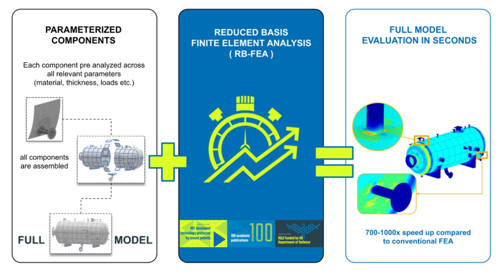
FIG. 3. The two stages of RB-FEA.
The key to applying this at scale is a component-based approach, where the building blocks of the digital twin are themselves parameterized. This allows a structural agent to modify parameters like geometry, material properties or loads on-the-fly without needing to perform any new, expensive FEA computations. The results are then checked against industry standards (e.g., API 579-1/ASME FFS-1 Fitness-For-Service), manufacturer specifications and maintenance logs.5
As the physics-based, industry-compliant results are displayed in real time, it solves the critical weak point of APM. Because it is focused on structural integrity, analysts call this structural performance management (SPM).1 Using SPM, the process and integrity team can have a live, dynamic view of the asset’s structural health. With both teams having a pulse check on the asset’s condition, this will finally close the gap between process and integrity teams (FIG. 4).
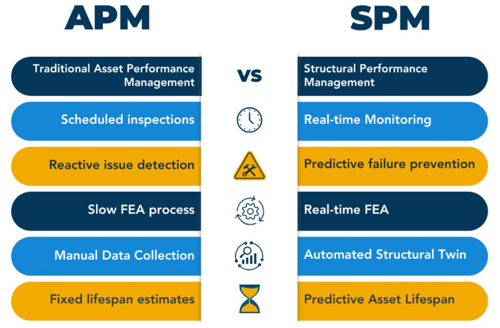
FIG. 4. APM vs. SPM.
The real question. Industry is approaching a point where not having a structural perspective in decision systems will be seen as a liability. AI agents will accelerate that shift because they expose, very quickly, where the data gaps are.
For the first time, industry personnel have the computational capability to bring structural insight into the same real-time domain where process optimization already operates. That convergence is what makes autonomous, or even semi-autonomous, operations genuinely possible.
The industry does not need more slogans about digital transformation. What it needs is for the asset itself to participate in the decision loop. That is the turning point.
This leads to two simple questions: How fast can we give our plants the structural intelligence they have always lacked; and, what new operating models become possible once we do?
LITERATURE CITED
1 Alam, S. and M. Tohani, “Smart innovators: Asset integrity and risk management software,” Vendantix, June 2025, online: https://akselos.com/wp-content/uploads/2025/09/Verdantix-Smart-Innovators-Asset-Integrity-And-Risk-Management-Software.pdf
2 Reynold, P., “From data to decisions: Unlocking asset integrity with structural performance management software,” Operational IT Research Group, March 2025, online: https://akselos.com/wp-content/uploads/2025/03/Peter-Reynolds-White-Paper.pdf
3 Akselos, “Structural Performance Management: Transforming How The World’s Most Critical Infrastructure Performs,” January 2026, online: https://akselos.com/wp-content/uploads/2026/01/SPM-Conference-Booklet-2025.pdf
4 World Economic Forum, “Global Lighthouse Network 2025: World Economic Forum recognizes 12 new sites driving holistic transformation in manufacturing,” September 16, 2025, online: https://www.weforum.org/press/2025/09/global-lighthouse-network-2025-world-economic-forum-recognizes-12-new-sites-driving-holistic-transformation-in-manufacturing/
5 Akselos, “Component-based reduced basis simulations,” 2022, online: https://akselos.com/wp-content/uploads/2022/10/white-paper-updated-component-based-rb-fea-08102018.pdf



Comments