

Repsol to install second 100-MW electrolyzer at its Petronor refinery
- The new plant for producing renewable hydrogen will require an investment of €292 million.
- The initiative has been recognised as an Important Project of Common European Interest (IPCEI) by the European Commission and will receive financial support from the Government of Spain through NextGenerationEU funds from the Recovery, Transformation, and Resilience Plan.
- The electrolyzer will have the capacity to produce up to 15,000 tons of renewable hydrogen annually, which will mainly be used at the company’s Petronor refinery in the vicinity of Bilbao in Northern Spain.
- With this new facility, Repsol and Petronor will contribute to the decarbonization of industry, preventing the emission of up to 167,000 tons of CO2 each year.
- Repsol is the leading producer and consumer of hydrogen in Spain and is present throughout the entire renewable hydrogen value chain.
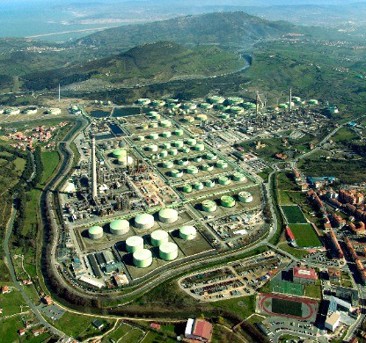
Repsol is making further progress in its industrial decarbonization strategy through renewable hydrogen and will install its second large-scale electrolyzer at its Petronor refinery in Muskiz close to Bilbao in Northern Spain. Last September, the company approved the construction in Cartagena of its first large electrolyzer, with a capacity of 100 megawatts (MW).
The new 100 MW infrastructure will require an investment of €292 million for commissioning in 2029. Recognised by the European Commission as an Important Project of Common European Interest (IPCEI), it will have the support of the Government of Spain and will receive €160 million through NextGenerationEU funds from the Spanish Recovery, Transformation, and Resilience Plan.
The electrolyzer will have the capacity to produce up to 15,000 tons of renewable hydrogen per year, which will mainly be used in processes at the Petronor refinery itself. As part of the Basque Hydrogen Corridor, it will also supply renewable gas to the region’s industry, driving its decarbonization with a key contribution, as it will prevent the emission of up to 167,000 tons of CO₂ per year, equivalent to the emissions saved by two-thirds of the 100% electric vehicle fleet in Spain in 2024.
The project, which represents a first-class technological challenge due to its scale, will generate around 900 direct, indirect, and induced jobs throughout its different phases. In addition, it builds upon advances already achieved at Petronor in the development of renewable hydrogen: in 2023, its first electrolyzer, with a capacity of 2.5 MW, was put into operation. The 350 tons of renewable hydrogen produced annually already supply the refinery and the building where Petronor's offices are located, in the Technology Park of the town of Abanto Zierbena in the province of Bilbao.
Likewise, in 2024, construction began at the port of Bilbao of a second 10 MW electrolyzer, which will supply the synthetic fuels demonstration plant that Repsol is building together with Aramco, and which is scheduled to start operations in 2026.
Second large electrolyzer
Repsol leads hydrogen production and consumption in the Iberian Peninsula, concentrating 60% of national production and contributing 4% of European consumption. In September 2025, Repsol gave the green light to its first large electrolyzer of 100 MW, which will be installed at its Cartagena complex.
The new renewable hydrogen plant will soon be joined by a large electrolyzer in Tarragona, with a capacity of 150 MW. Like those atthe complexes in Cartagena and Petronor, it will mainly supply Repsol’s industrial complex. It is also expected to provide renewable hydrogen to the future Ecoplanta – which will produce renewable methanol from municipal waste – and to other local industries.

Comments