


Alberta oil regulator stopped enforcing gas flaring limits after government pressure
- Alberta Energy Regulator did not enforce flaring limit exceedance
- Flaring limit removal highlights Canada's economic vs. environmental challenge
- Canada aims to end routine flaring by 2030, despite rising flaring in Alberta
The regulator in charge of environmental enforcement in Canada's main oil-producing province bent to pressure from the provincial government and oil companies to eliminate a limit on natural gas flaring as Canadian oil production increased, according to documents.
Alberta's dismantling of its 20-yr-old flaring limit after companies blew through the limit two years in a row, with no objections from the federal government, is an example of the challenges Canada faces in reconciling its environmental commitments with a renewed focus on economic growth.
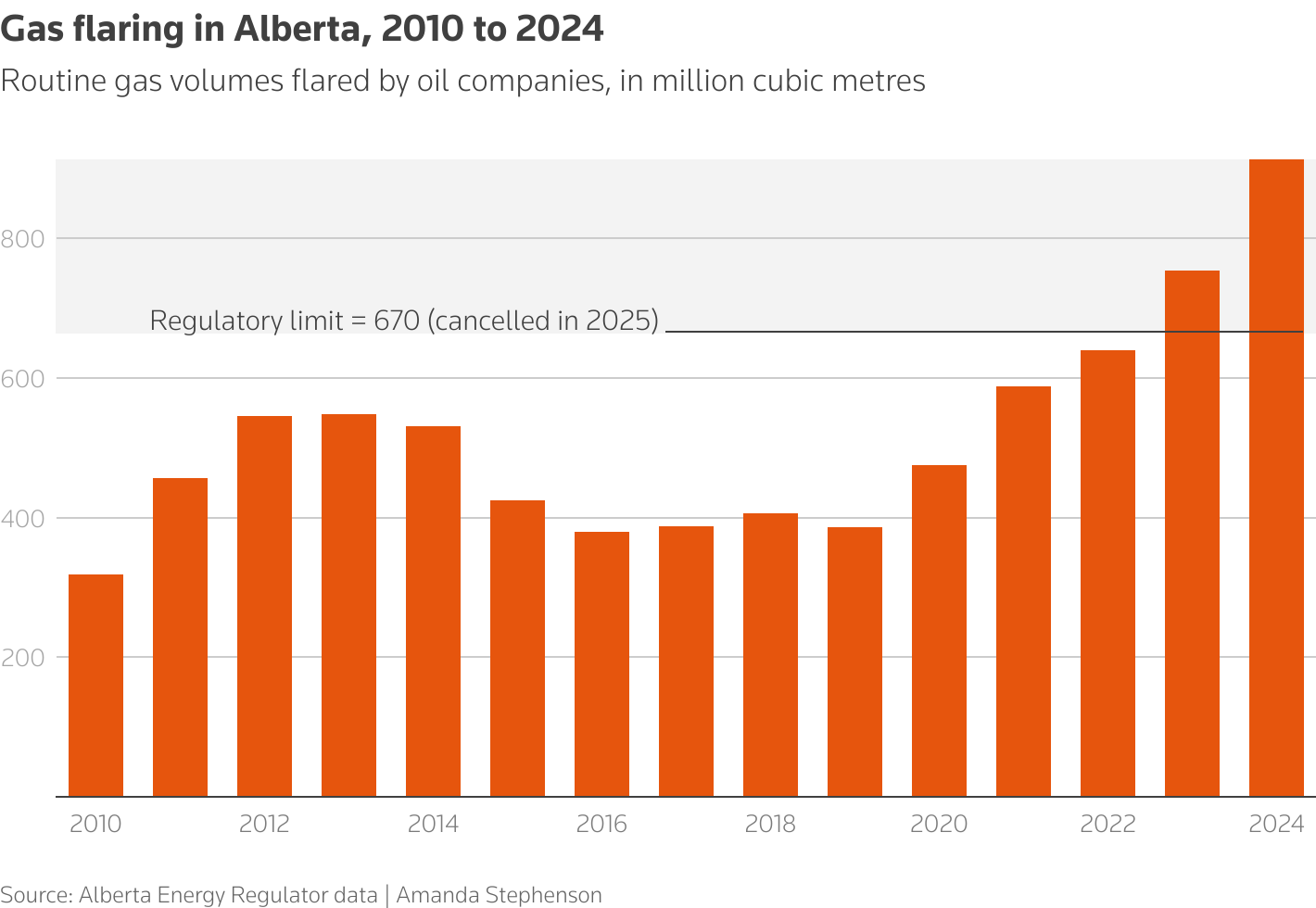
(click image to enlarge)
The documents, obtained through access to information laws, show the Alberta Energy Regulator sent letters to 20 companies in the spring of 2024 threatening to enforce flaring limits — which could have resulted in curtailed oil production — if the operators did not prepare and implement plans for lowering their flaring volumes.
But the plans that operators, including U.S.-based Murphy Oil and Canada's Tamarack Valley Energy, submitted were unenforced. By June 2025, the regulator quietly did away with flaring limits in response to directives from Alberta government officials.
‘Humble and collaborative’ approach. In the lead-up to that decision, the government urged the regulator to take a "softer" tone in its communication with offending companies, taking a "humble and collaborative" approach, previously unreported email records show.
“It is desirable to work with our industry partners to address this issue," an Alberta Environment Department official wrote to the regulator. The regulator, described by the Alberta government as an arm's-length independent body, was urged to implement the change with "no proactive communications or announcements."
The AER said in an email it did not follow through with enforcement because the flaring policy was under review and it had disclosed the end of the flaring limit in a regulatory filing on its website.
Regulator and government staff gathered industry feedback together on the flaring policy's effectiveness, said Alberta Environment spokesperson Tom McMillan.
"The comments in question were from staff-to-staff discussions about the tone of communication and engagement approach — not any compliance or enforcement action," McMillan said.
Flaring limit seen as production cap. Flaring is the practice of burning off excess natural gas associated with oil production.
Canada, the world's fourth-largest oil producer, achieved record-high oil production last year. Prime Minister Mark Carney, a former UN special envoy on climate action who is seeking to diversify the economy away from the U.S. and the uncertainties of U.S. President Donald Trump's tariffs, has said he wants Canada to become an "energy superpower."
But Canada's energy sector has said many of the country's environmental rules get in the way of expanding oil output. The documents show the regulator faced pushback from companies about the flaring limit, which one industry group said could serve as a de facto production cap.
Carney signed an agreement with Alberta on Thursday to drop its planned emissions cap on the oil and gas sector.
Climate implications. Companies sometimes flare gas when there are no pipelines nearby to transport the gas.
From a climate change perspective, flaring can be preferable to venting, or releasing the excess gas directly into the atmosphere without burning it first. Venting produces large amounts of methane, an extremely potent greenhouse gas. Alberta has cut its methane emissions from the oil and gas sector in half over the past decade.
A spokesperson for Canada's Environment Department said flaring can be a short-term solution for reducing methane emissions if companies that vent natural gas switch to flaring.
However, she said Canada recognizes that flaring contributes to climate change by emitting carbon dioxide and other pollutants.
International commitments. Canada is a signatory to a World Bank initiative that commits countries to ending routine flaring by 2030.
Along with 10 other countries, Canada endorsed a statement at the recent COP30 summit recognizing the importance of ending routine venting and flaring by 2030.
Other major oil producers such as the United States, Russia and Iran flare more gas than Canada. The European Union has stronger regulations than Canada, including an outright ban on routine flaring, which is done for reasons other than emergencies or safety.
But regulatory data shows flaring has been rising in Alberta. Oil and gas producers in the province flared approximately 912.7 MMm3 of natural gas in 2024, exceeding the annual provincial limit by 36%.
AER data for the first nine months of 2025 show Alberta's oil producers are on track this year to again exceed the now-cancelled flaring limit.
"There's a clear gap here between commitments and policy," said Amanda Bryant, senior analyst with the Pembina Institute, a clean energy think-tank. "Especially when there are plenty of viable alternatives to flaring."

Comments