


Shell Insights: Behind the rise of LNG trucks in China
- In just five years, the number of trucks powered by liquefied natural gas (LNG) in China has almost tripled, helping to reduce air pollution and reshape an industry long dominated by diesel.
- Note: This article was originally featured on Shell's website: https://www.shell.com/news-and-insights/our-stories/behind-the-rise-of-lng-trucks-in-china.html
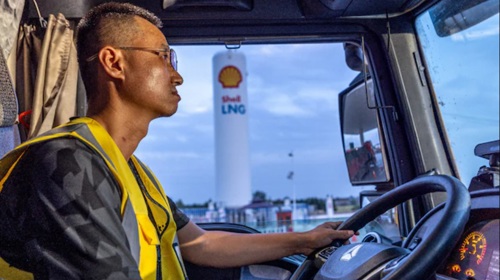
Right outside the city of Xi’an, once the gateway to the ancient Silk Road and now a major logistics hub in central China, Xuejun Ma pulls his 40-tonne truck into a Shell mobility station to fill up. It is a brief stop on a round trip from Xi’an to Urumqi and back, a long-haul, 5,000-kilometre journey Xuejun and his co-driver complete every week. “We move express online orders,” says Xuejun. “My colleague and I take turns sleeping on the small bunk behind the cabin, but the truck rarely rests.”
A bright yellow truck, its cabin neatly kept with a family photo tucked against the window, is the fifth in Xuejun’s career but the first to run on liquefied natural gas (LNG). In 2022, Yunda Express − the company he drives for − replaced 50 diesel-fuelled, heavy-duty trucks at its Xi’an branch with LNG-powered alternatives. “The driving feels the same, but the difference in exhaust fumes is hard to miss – they have dropped significantly,” Xuejun says.
Xuejun’s experience reflects a shift underway in China’s road-freight industry, one of the largest in the world. According to the China Association of Automobile Manufacturers, the number of LNG vehicles on Chinese roads has almost tripled since 2019, offering other countries a vision of not only how to help reduce air pollution – but also how to cut emissions generated by heavy-duty trucking. Today, road freight accounts for 4% of global greenhouse gas emissions, more than shipping and aviation combined.
LNG can help to reduce carbon emissions compared with oil-based fuels, as well as emissions of fine particulate matter and nitrogen oxides – two pollutants linked to smog and respiratory illness. To deliver the full greenhouse benefits of LNG, methane emissions must be minimized.
Restrictions and Incentives. To encourage the use of lower-carbon fuels than diesel, China has introduced restrictions and incentives. It has limited access for diesel trucks in urban zones, for example, subsidized lower-emission alternatives and created dedicated lanes for LNG vehicles in nearly 300 cities. In industries such as steel and coking, new rules require most road freight to be carried by electric or LNG vehicles.
At the same time, the government has invested in infrastructure. Over the past two decades, China has built an expansive natural gas network – laying pipelines, expanding LNG import terminals and regasification facilities, adding liquefaction plants, and opening thousands of LNG refueling stations.
Lower fuel costs are also a reason to switch to LNG, which cuts expenses compared with diesel. That helps to offset the higher price of LNG-powered trucks.
In 2024, sales of heavy-duty natural gas trucks in China reached 178,200 units, a 17% increase compared to 2023, according to CV World, a Beijing-based commercial vehicle research provider. Although sales slowed in the first half of 2025, as diesel prices fell and adoption of electric alternatives rose sharply, LNG trucks remain attractive, especially for long distances.
“LNG has become a strategic energy pillar for China, thanks to its cost advantages and lower carbon footprint compared to diesel,” says Hu Chuan, Vice President for Mobility and Convenience, Shell China. “It has also sped up the replacement of diesel vehicles in transportation, a trend that is in line with China’s national energy goals, and Shell China has responded to this trend to best meet our customers’ needs.”
Shell China entered the LNG retail market in Shaanxi Province in 2017 and now runs 16 LNG stations across China.
Potential markets. Other countries are using natural gas for heavy-duty transport. According to the European Alternative Fuels Observatory, there were close to 700 LNG refuelling stations in the European Union by August 2025, almost double the amount in 2020, with most in Germany and Italy.
India, meanwhile, is building out its gas and LNG infrastructure. Currently, compressed natural gas (CNG) is more commonly used for transport. But CNG is less practical for heavy-duty trucks, as it requires a greater fuel volume to travel the same distance as LNG or diesel. In June, India’s Petroleum and Natural Gas Regulatory Board said in a report that LNG was “likely to emerge as the preferred transportation fuel” for heavy-duty trucks after 2030.
Back in China, as Xuejun Ma prepares for another 5,000-kilometer journey, he reflects on how his LNG-powered truck helps to keep China’s e-commerce running. “It feels good to work for one of the top delivery companies,” he says. “Between every shopper and their online order is a real distance, and it is people like us who help to bridge it.”


Comments